

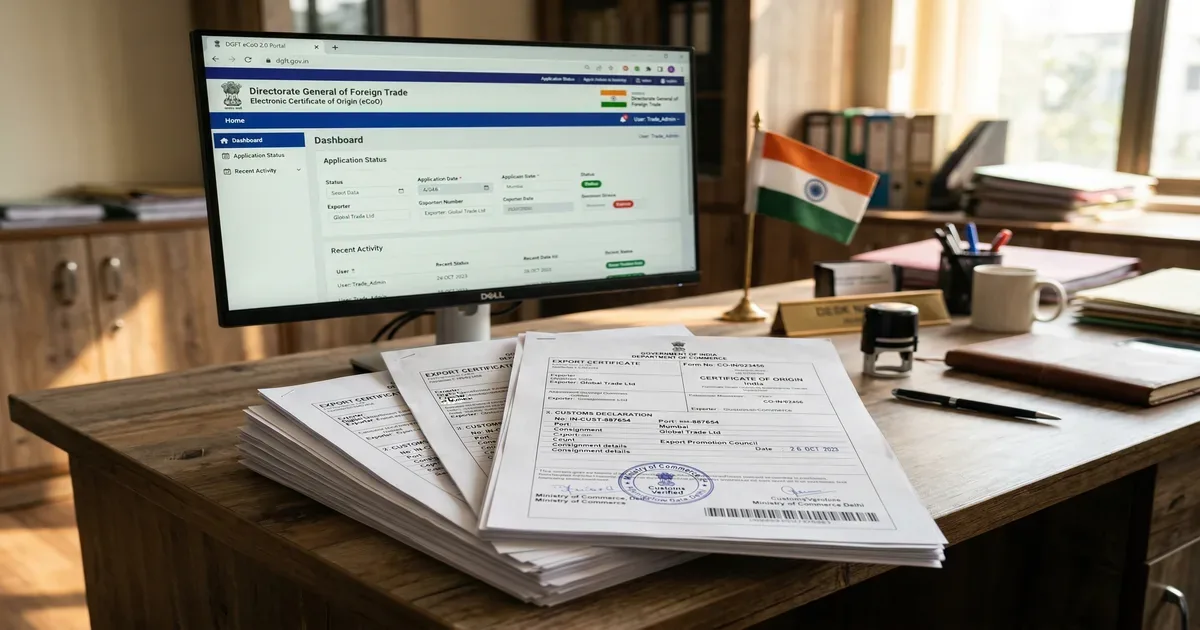
India issues Certificates of Origin (CoO) through six DGFT-authorized agencies: DGFT itself, Indian Chambers of Commerce (ICC), Engineering Export Promotion Council (EEPC), Federation of Indian Export Organisations (FIEO), Export Inspection Council (EIC), and Marine Products Export Development Authority (MPEDA). Applicants must apply via the DGFT eCoO 2.0 portal at www.trade.gov.in, hold a valid IE Code and DGFT-registered DSC (Class 3), and pay agency-specific fees ranging from Rs.250 to Rs.1,500 per certificate.
Which Agencies Issue Certificates of Origin in India?
India has six DGFT-authorized CoO issuing agencies, each with specific product mandates. DGFT issues CoOs for all products directly. ICC and FIEO cover broad product categories across their exporter memberships. EEPC specializes in engineering goods. EIC handles food and pharmaceutical exports. MPEDA covers marine and seafood products. Understanding which agency covers your product category determines where you should apply — applying to the wrong one is one of the most common reasons applications get delayed or rejected.

How Do I Apply for a Certificate of Origin on the eCoO 2.0 Portal?
The primary channel for CoO applications in India is now the DGFT eCoO 2.0 portal at www.trade.gov.in. Here is the step-by-step:
Step 1: Register on www.trade.gov.in. Create an account using your IE Code and link a Class 3 Digital Signature Certificate. The old portal at coo.dgft.gov.in was decommissioned on 1 March 2025 and now redirects to www.trade.gov.in.
Step 2: Select your agency. Choose DGFT, ICC, EEPC, FIEO, EIC, or MPEDA based on your product category.
Step 3: Fill in the application. Enter exporter details, product description (with HSN code), country of origin, destination country, and FTA or preferential claim if applicable.
Step 4: Upload documents. Commercial invoice, packing list, bill of lading or airway bill, and any FTA-specific rules-of-origin documents.
Step 5: Pay fee and submit. Pay the agency-specific fee online. DGFT migrated all e-wallet balances from the old coo.dgft.gov.in to the new www.trade.gov.in on 1 March 2025.
Step 6: Receive the certificate. The certificate is issued electronically and can be downloaded from the portal. Track status from your dashboard.
ICEGATE (icegate.gov.in) handles e-filing for some agencies but is secondary to www.trade.gov.in for most exporters. For complex preferential applications involving detailed rules-of-origin documentation, many exporters still apply in person through their chamber of commerce, where a certification officer can review the manufacturing documentation directly.
What Documents Do I Need for a Certificate of Origin Application?
The standard requirements are:
- Valid IE Code (issued by DGFT)
- GST registration
- Class 3 Digital Signature Certificate registered with DGFT
- Commercial invoice with product description and HSN code
- Packing list
- Bill of lading or airway bill
- For preferential certificates: rules-of-origin documentation including country of manufacturing, bill of materials, and origin criteria compliance certificate
FTA-specific certificates may require additional origin declaration forms. The exact documents needed also depend on which agency you are applying through and which trade agreement you are claiming under.
What Are the Fees Charged by Each CoO Issuing Agency?
Fees vary by agency and certificate type. Members of ICC, EEPC, and FIEO typically receive discounted rates.
| Issuing Agency | Fee Range (Rs.) | Certificate Type | Turnaround Time | Product Scope |
|---|---|---|---|---|
| DGFT | 250–500 | Non-preferential / Preferential | 1–2 working days | All products |
| Indian Chambers of Commerce (ICC) | 500–1,500 | Non-preferential / Preferential | 1–3 working days | All products |
| Engineering Export Promotion Council (EEPC) | 750–1,200 | Non-preferential / Preferential | 1–2 working days | Engineering goods |
| Federation of Indian Export Organisations (FIEO) | 500–1,500 | Non-preferential / Preferential | 1–3 working days | All products |
| Export Inspection Council (EIC) | 250–750 | Non-preferential | 1–2 working days | Food, pharmaceuticals |
| Marine Products Export Development Authority (MPEDA) | 250–500 | Non-preferential / Preferential | 1–2 working days | Marine products |
DGFT charges the lowest fees and is the default agency for exporters without a membership in the other councils. ICC, EEPC, and FIEO members typically pay less than non-members.
How Long Does It Take to Get a Certificate of Origin?
Standard processing ranges from 1 working day at DGFT to 3 working days at FIEO and ICC for non-members. Expedited processing, same-day or 24-hour, is available at most agencies at 1.5 to 2 times the standard fee. EIC and MPEDA typically process within 1–2 working days for their respective product categories.
What Is the Difference Between Preferential and Non-Preferential Certificates of Origin?
A preferential Certificate of Origin is used when claiming reduced or zero customs duty under a Free Trade Agreement (FTA) or unilateral preference scheme like GSTP. It requires proof that the product meets the specific rules of origin criteria set out in the agreement. A non-preferential Certificate of Origin certifies the country of origin without claiming any tariff concession — it is used for general trade documentation purposes and is commonly required by importing country customs authorities, banks, or buyers for regulatory compliance.
India has 13+ active trade agreements, including India-ASEAN FTA (AIFTA), India-Japan CEPA, India-Korea CEPA, India-Singapore CECA, India-Malaysia CECA, India-UAE CEPA (2022, major agreement), India-Australia ECTA, India-Mauritius IPCEA, India-Sri Lanka FTA, and others. A full list is on the DGFT website at www.trade.gov.in.
To use a preferential CoO, your goods must meet the rules of origin in the relevant agreement. These typically require either that the goods are wholly obtained in the exporting country, or that a specified amount of manufacturing or processing took place there, expressed as a minimum percentage of local content or a change in tariff classification at a required level.
Preferential CoOs are issued on forms prescribed by each agreement (commonly Form A or equivalent) and must be certified by an authorized agency. Your buyer then presents the certificate to their customs authority to claim the preferential rate.
| Preferential CoO | Non-Preferential CoO | |
|---|---|---|
| Purpose | Claim FTA tariff benefits | MFN duty, anti-dumping, labelling |
| Rules of origin | Must be satisfied | Simple declaration of origin |
| Form | Agreement-specific (e.g., Form A) | Standard format |
| Duty outcome | Reduced or zero | Standard MFN rate applies |
How Has the eCoO 2.0 Migration Affected Applicants?
DGFT migrated the entire Certificate of Origin system from the old coo.dgft.gov.in portal to the new www.trade.gov.in on 1 March 2025. The old portal now redirects to www.trade.gov.in — anyone still trying to access coo.dgft.gov.in directly will find it pointing to the new site.
For applicants who had existing e-wallet balances on the old portal, DGFT migrated those balances automatically to the new www.trade.gov.in account. If your balance did not transfer, you should raise a grievance at www.trade.gov.in/grievance or contact your regional DGFT RA.
All new applications, both preferential and non-preferential, must now be filed at www.trade.gov.in. The key prerequisites for the new portal are a valid IE Code and a Class 3 Digital Signature Certificate registered with DGFT. Class 2 DSC is no longer supported.
The migration also brought all six authorized agencies — DGFT, ICC, EEPC, FIEO, EIC, and MPEDA — onto the same unified portal, making it easier to track applications across agencies from a single dashboard. Exporters who applied through multiple agencies previously had to maintain separate logins and accounts. That has been consolidated.
For exporters who had applications in progress on the old portal around the March 2025 migration date, DGFT extended processing timelines for affected cases. Check the status of any legacy application through your new www.trade.gov.in dashboard.
Frequently Asked Questions
How do I apply for a Certificate of Origin in India?
To apply for a Certificate of Origin in India, first register on the DGFT eCoO 2.0 portal at www.trade.gov.in using your IE Code and a Class 3 Digital Signature Certificate. Then select your issuing agency from DGFT, ICC, EEPC, FIEO, EIC, or MPEDA based on your product category, fill in the product and destination country details, and upload the required documents along with the fee payment. The certificate is issued electronically within the turnaround time of your chosen agency. For preferential certificates under an FTA, you must also include rules-of-origin documentation showing your product meets the agreement criteria, such as minimum local content or qualifying change in tariff classification. Your chosen agency will verify the documentation before issuing the certificate.
Which agencies are authorized to issue Certificates of Origin in India?
Six agencies are authorized by DGFT to issue Certificates of Origin in India: the Directorate General of Foreign Trade (DGFT) itself, Indian Chambers of Commerce (ICC), Engineering Export Promotion Council (EEPC), Federation of Indian Export Organisations (FIEO), Export Inspection Council (EIC), and Marine Products Export Development Authority (MPEDA). Each covers specific product categories and export destinations. DGFT handles all products directly. ICC and FIEO serve broad exporter memberships across categories. EEPC covers engineering goods. EIC handles food and pharmaceutical exports. MPEDA covers marine and seafood products. Choosing the right agency for your product category is the first decision in the application process.
What is the fee for a Certificate of Origin from different agencies?
Fees vary by agency: DGFT charges Rs.250 per certificate for electronic filing (Rs.500 for manual applications). ICC charges Rs.500–Rs.1,500 depending on certificate type and membership tier. EEPC charges Rs.750–Rs.1,200 for engineering goods. FIEO charges Rs.500–Rs.1,500. EIC charges Rs.250–Rs.750 for food and pharmaceutical exports. MPEDA charges Rs.250–Rs.500 for marine products. DGFT is the cheapest option for exporters without a membership in the other councils, while ICC, EEPC, and FIEO members typically receive discounted rates on their certificates. Fees are subject to change, and you should verify the current schedule on the respective agency website before applying.
What is the difference between preferential and non-preferential Certificates of Origin?
A preferential Certificate of Origin is used when claiming reduced or zero customs duty under a Free Trade Agreement (FTA) or unilateral preference scheme like GSTP. It requires proof that the product meets the specific rules of origin criteria in the relevant agreement. A non-preferential Certificate of Origin is used for general trade documentation purposes, to certify the country of origin without claiming any tariff concession, and is commonly required by importing country customs authorities, banks, or buyers for regulatory compliance. The preferential type requires rules-of-origin analysis and documentation. The non-preferential type requires only a declaration of origin verified by the certifying agency.
How has the eCoO 2.0 migration affected Certificate of Origin applicants?
DGFT migrated the Certificate of Origin system from the old coo.dgft.gov.in to the new www.trade.gov.in portal on 1 March 2025. Applicants who had existing e-wallet balances on the old portal had their balances migrated automatically to the new portal. All applications, fee payments, and certificate issuance now run exclusively on www.trade.gov.in, with certificates issued electronically and tracking available through the www.trade.gov.in dashboard. New users must create an account on www.trade.gov.in, link their IE Code, and register a Class 3 Digital Signature Certificate (Class 2 DSC is no longer accepted). The migration also brought all six authorized agencies onto a single dashboard, making it easier to manage applications across multiple agencies.
The Certificate of Origin is one of those documents that only becomes visible when something goes wrong. A wrong agency application, an expired certificate, or a rules-of-origin gap in a preferential claim can result in unexpected duties, border holds, or a denied preferential rate — none of which show up until the shipment is already in transit.
Eximoz automates Certificate of Origin tracking, agency fee management, and expiry alerts so your team never misses a renewal or submits to the wrong agency. If you want to see what automated compliance checking looks like for your import or export operation, book a 15-minute call with us at https://eximoz.com/demo.