

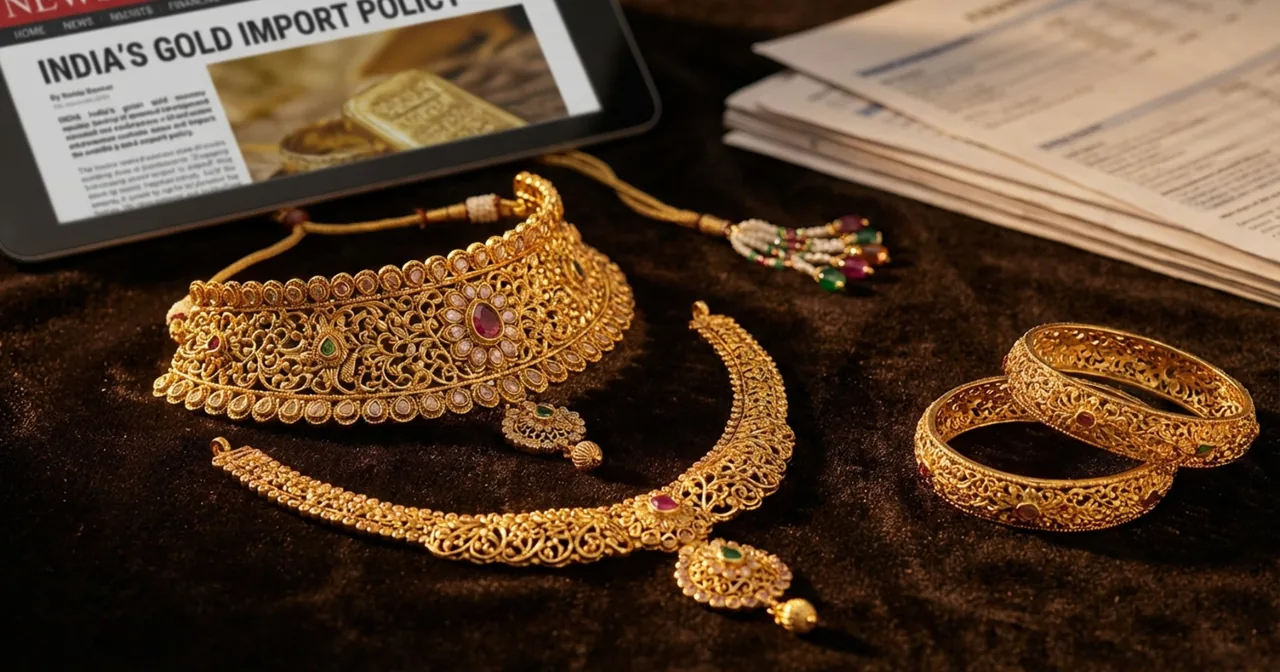
DGFT Notification No. 02/2026-27 dated 1 April 2026 has changed the import policy for jewellery under CTH 7113 from “Free” to “Restricted” with immediate effect – gold, silver and platinum jewellery imports now require a DGFT import licence, with exemptions only for EOUs, SEZs and India-UAE CEPA tariff-rate-quota (TRQ) shipments.
What changed in India’s jewellery import policy in April 2026?
On 1 April 2026 the Directorate General of Foreign Trade (DGFT) issued Notification 02/2026-27. The single-page notification moves multiple sub-headings under Chapter 71 heading 7113 (articles of jewellery) from the “Free” import category to the “Restricted” category.
Key points:
-
Immediate effect: The change applies to Bills of Entry filed on or after 1 April 2026. There is no grandfathering for existing letters of credit or purchase orders.
-
Policy Condition 7 introduced: Importers must obtain an import licence from DGFT headquarters in New Delhi before clearance. Licences are consignment-specific and valid for six months.
-
Part of a broader clamp-down: The jewellery restriction precedes Notification 03/2026-27 (2 April 2026), which tightens raw and semi-manufactured precious-metal imports. Together they aim to curb India’s widening current-account deficit after the 2024 customs-duty cut on gold inflows.
-
Targeted at finished jewellery: Raw bullion and semi-fabricated products fall under other headings; this notification focuses on finished gold, silver and platinum jewellery ready for retail.
Which jewellery items are now restricted under DGFT Notification 02/2026-27?
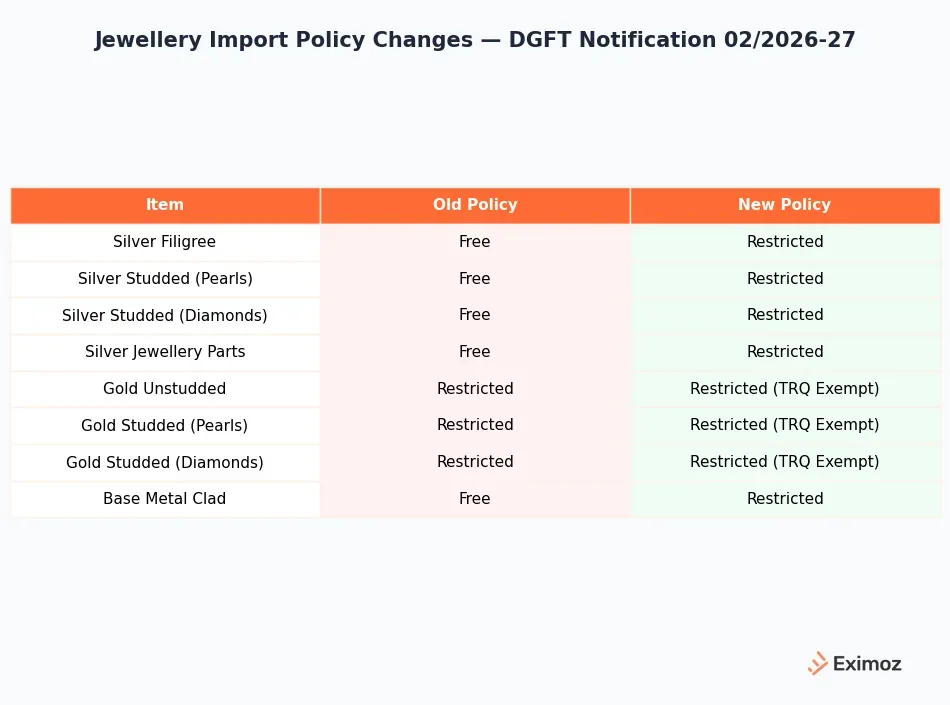
The table below summarises the exact tariff lines and the new policy stance.
| ITC-HS Code | Description | Old Policy | New Policy | CEPA Exempt? |
|---|---|---|---|---|
| 7113 11 10 | Silver filigree jewellery | Free | Restricted | No |
| 7113 11 42 | Silver jewellery studded with pearls | Free | Restricted | No |
| 7113 11 43 | Silver jewellery with diamonds (7102) | Free | Restricted | No |
| 7113 11 90 | Other silver jewellery parts | Free | Restricted | No |
| 7113 19 11 | Gold unstudded jewellery | Restricted | Restricted | Yes (TRQ) |
| 7113 19 12 | Gold jewellery studded with pearls | Restricted | Restricted | Yes (TRQ) |
| 7113 19 13 | Gold jewellery with diamonds (7102) | Restricted | Restricted | Yes (TRQ) |
| 7113 20 | Base-metal jewellery clad with precious metal | Free | Restricted | No |
Silver jewellery is the biggest new entrant to the Restricted list. Gold jewellery was already technically restricted, but the new Policy Condition 7 clarifies the licensing requirement and records the CEPA exemption (see next section).
Can I still import gold jewellery under the India-UAE CEPA?
Yes – but only within the annual tariff-rate quota.
Under the India-UAE Comprehensive Economic Partnership Agreement (CEPA) signed in 2022, the UAE enjoys a TRQ for a progressive annual tariff-rate quota (reaching up to 200 tonnes for FY 2026-27) of gold jewellery (ITC-HS 7113 19 11–19). Imports within the unused quota balance continue to enter India at the agreed 1% BCD and do not require a separate DGFT licence. Customs will, however, insist on:
-
A valid TRQ allocation letter issued by DGFT for the financial year 2026-27.
-
A Certificate of Origin (Form AIC) issued by an authorised UAE agency.
-
End-use bond confirming the goods will not be diverted to DTA sales if imported by an EOU or SEZ.
Any shipment that exceeds the quota or lacks paperwork falls back to the Restricted route – i.e., licence required and full duty payable.
Are EOU and SEZ jewellery exporters exempt from the new restrictions?
Export-oriented units (EOUs) and Special Economic Zone (SEZ) units remain exempt, provided the jewellery is not diverted to the Domestic Tariff Area (DTA).
-
EOUs: Para 6.01(d) of the Foreign Trade Policy 2023 lets EOUs import inputs duty-free. Finished jewellery for export therefore remains unaffected, but any DTA sale will need a licence.
-
SEZs: Rule 27 of the SEZ Rules 2006 offers a similar carve-out for SEZ units, again conditional on 100% re-export or sale to other authorised SEZ/EOU units.
-
Gems & Jewellery export promotion schemes: Chapter 4 (Advance Authorisation, DFIA) benefits continue. However, importers must quote their authorisation number on the Bill of Entry for faster assessment.
Customs officers are already flagging consignments for secondary checks to ensure goods declared for re-export are not leaking into the domestic market.
How to apply for a jewellery import licence from DGFT
-
Login to the DGFT portal (https://dgft.gov.in) using your IEC-linked credentials.
-
Go to Services → Import Management → Restricted Imports Licence.
-
Choose “CTH 7113 Jewellery” from the dropdown list and fill in the sub-heading and product description exactly as per the tariff schedule.
-
Upload the following mandatory documents (PDF, <5 MB each):
- Pro-forma invoice or purchase order
- Chartered Engineer certificate attesting to description and value
- GST registration certificate
- Past import performance statement (if any)
-
Pay the application fee of INR 1,000 online via Bharatkosh.
-
Submit and download the acknowledgement.
DGFT headquarters aims to process straightforward applications within 3–5 working days. You will receive an e-signed licence PDF, which must be presented in the e-Sanchit document set while filing the Bill of Entry.
Tip: Use the “Track Status” option in your DGFT dashboard; status fields update in near real time.
Frequently Asked Questions
Can I still import gold jewellery into India after 1 April 2026?
Only with a valid DGFT import licence. The sole exception is gold jewellery shipped under a live India-UAE CEPA TRQ allocation.
Is silver jewellery import also restricted now?
Yes. All silver jewellery sub-headings under 7113 have moved from Free to Restricted. A licence is compulsory regardless of value or quantity.
What is the India-UAE CEPA exemption for jewellery imports?
CEPA grants the UAE a duty-concession quota for specific gold jewellery tariff lines. Shipments within the unused quota do not need a DGFT licence but must carry TRQ and origin documents.
How does Notification 02/2026-27 relate to Notification 03/2026-27?
Notification 02 targets finished jewellery (CTH 7113). Notification 03, issued the next day, extends restrictions to raw bullion, coins and semi-manufactured forms (7112, 7108 etc.). Together they close both finished and upstream supply routes.
How long will it take to get a jewellery import licence from DGFT?
DGFT’s service charter promises 3–5 working days, but initial backlog may stretch this. File applications early and track status daily.
Stay ahead of policy shocks
Import policy changes can catch you mid-shipment. Eximoz monitors DGFT notifications in real time and alerts you the moment your product’s import policy changes – eximoz.com.