

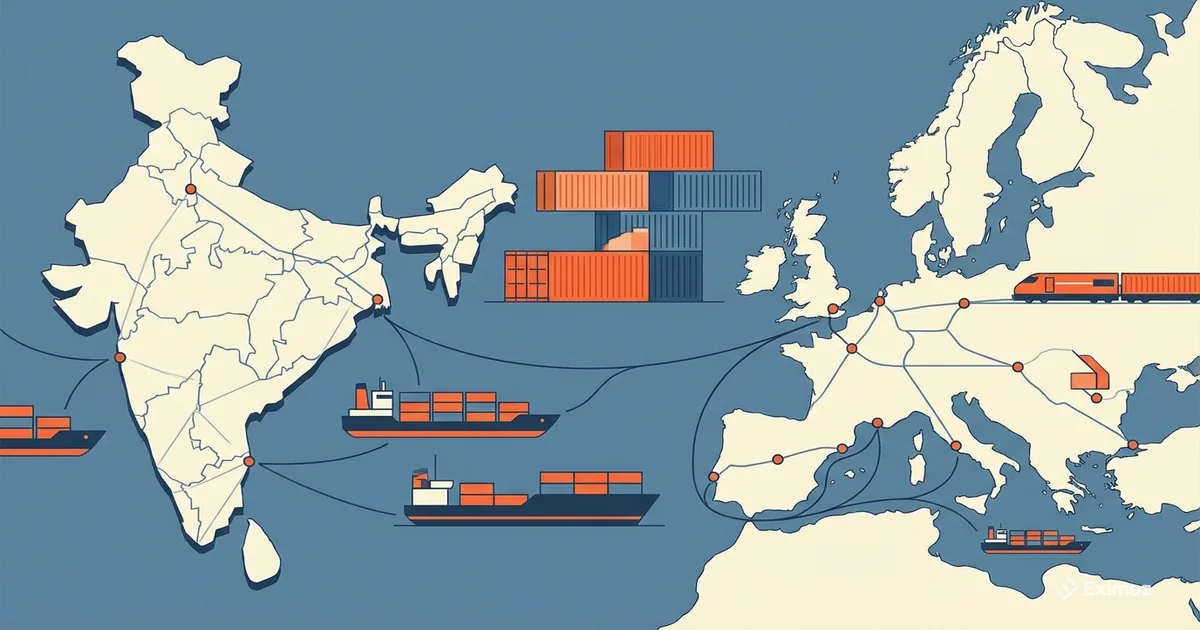
The India-EU Free Trade Agreement concluded on January 27, 2026, creating one of the world's largest free trade zones, with phased tariff reductions covering textiles, pharmaceuticals, automobiles, and agricultural products. For Indian exporters, this means lower duties on goods entering 27 EU member states, but only if classification, compliance, and documentation are handled correctly from day one.
What is the India-EU FTA and when does it take effect?
India and the European Union formally concluded free trade negotiations on January 27, 2026, after more than a decade of stop-start talks that began in 2007 and were relaunched in 2022. The agreement covers goods, services, investment protection, and government procurement across all 27 EU member states.
Ratification is expected to take 12-18 months. Both the European Parliament and India's Parliament need to approve the final text before implementation begins. Once ratified, tariff reductions roll out in two phases:
-
Phase 1 (effective from ratification): Immediate tariff cuts on textiles, pharma APIs, and IT services liberalization
-
Phase 2 (3-5 years post-ratification): Gradual reductions on auto components, agricultural products, and remaining sensitive categories
Indian exporters should not wait for ratification to prepare. The compliance requirements, especially rules of origin documentation and EU regulatory standards, take months to set up. Exporters who start now will be first to claim preferential tariffs once the agreement goes live.
Figure 1: Projected tariff eliminations under the India-EU Free Trade Agreement for major export sectors
Source: PIB Press Release PRID 2219065, 27 January 2026; European Commission Press Release IP/26/184
Which Indian export sectors benefit most from the India-EU FTA?
Five sectors stand to gain the most from reduced EU tariffs:
| Sector | Current EU tariff | Expected FTA tariff | Phase |
|---|---|---|---|
| Textiles | 12% | 0-4% | Phase 1 |
| Pharma APIs | 6.5% | 0% | Phase 1 |
| Auto components | 4.5% | 0% | Phase 2 |
| Basmati rice | €175/tonne | Reduced TRQ | Phase 2 |
| IT services | N/A | Enhanced mode 4 | Phase 1 |
Textiles and garments are the biggest winner. India's textile exports to the EU were worth $8.4 billion in 2024-25, but tariffs of 9.6-12% made Indian goods less competitive against Bangladesh and Vietnam, both of which already had preferential access. Under Phase 1, most textile categories drop to 0-4%.
Pharmaceuticals benefit from zero duty on APIs under Phase 1. India already supplies roughly 25% of the EU's generic medicines, and removing the 6.5% duty makes Indian APIs more competitive against Chinese alternatives.
Auto components face a longer wait. The 4.5% tariff drops to zero only in Phase 2 (3-5 years after ratification). Manufacturers in Pune, Chennai, and Gurugram who supply European OEMs should start preparing rules of origin documentation now.
Agricultural products get mixed treatment. Basmati rice moves to a reduced tariff rate quota (TRQ) rather than full duty elimination. Spices, tea, and marine products also see reductions, though exact schedules are pending.
IT services gain through enhanced Mode 4 commitments, meaning easier movement of Indian professionals to EU member states for project-based work.
Source: PIB PRID 2219250 — Textile & Apparel Sector Tariff Details
What challenges do Indian exporters face under the EU FTA?
Lower tariffs come with conditions. Four hurdles stand between Indian exporters and actual FTA benefits:
Rules of origin: To claim preferential tariffs, your goods must qualify as "originating" in India. This means a minimum percentage of value addition must happen in India. If you import raw materials from China, process them, and export to the EU, you may not qualify. Every shipment needs a preferential Certificate of Origin.
REACH compliance: The EU's REACH regulation applies to all chemical substances exported to Europe. Indian chemical and pharma exporters must register substances with the European Chemicals Agency (ECHA). Without REACH registration, your goods cannot enter the EU regardless of tariff rates.
CBAM (Carbon Border Adjustment Mechanism): The EU's CBAM requires importers to report embedded carbon emissions in steel, cement, aluminium, fertilisers, and hydrogen. Indian exporters in these sectors must calculate and declare their carbon footprint per product. The reporting phase is already active; financial adjustments begin in 2026.
Technical barriers: EU product standards for food safety (EFSA), machinery (CE marking), and electronics (RoHS) are among the strictest globally. The FTA does not waive these requirements. It only reduces tariffs.
The bottom line: tariff reduction is only useful if you can comply with the non-tariff requirements. Many Indian SMEs will need to invest in testing, certification, and documentation before they can take advantage of the FTA.
Source: European Commission — EU-India Trade Agreement
How does the India-EU FTA compare to India's other FTAs?
India has been active on trade agreements. Here's where the EU FTA fits:
India-EFTA TEPA (signed March 2024): Covers Switzerland, Norway, Iceland, and Liechtenstein with a $100 billion investment commitment over 15 years. Smaller market (4 countries vs. 27 in the EU) but opens access to Swiss pharma and Norwegian energy technology. The EFTA deal and EU FTA together give Indian exporters preferential access across nearly all of Europe.
India-UK FTA (ongoing): Negotiations continue post-Brexit. Progress has been slow, with disagreements on agriculture and services mobility.
India-Australia ECTA (effective 2023): Already in force, with eliminated tariffs on 85% of Australian goods and reduced duties on Indian textiles and agricultural products entering Australia.
The EU FTA is the largest of India's recent trade agreements by market size. The EU is India's 2nd largest trading partner after the US, with bilateral trade worth $131 billion in 2024-25.
Source: India Briefing — FTA Tracker 2026
How should Indian exporters prepare for the India-EU FTA?
-
Verify your HS classification. Preferential tariffs are mapped to specific HS codes. If your product is classified under the wrong code, you miss the tariff benefit or claim a reduction you're not entitled to, which triggers penalties on audit.
-
Set up rules of origin documentation. Start tracking your input sourcing, value addition, and manufacturing processes now. You'll need this for the preferential Certificate of Origin.
-
Check EU regulatory requirements. REACH for chemicals, CE marking for industrial products, EFSA standards for food. Identify which apply to your products and start certification.
-
Calculate your CBAM exposure. If you export steel, cement, aluminium, or fertilisers, calculate your embedded emissions per tonne now.
-
Talk to your CHA or freight forwarder. Your customs broker needs to be ready to file under the FTA's preferential regime from day one.
FTA preferential tariffs depend on correct HS classification. A product classified under the wrong heading doesn't just miss the duty reduction; it can trigger an origin verification that delays the entire consignment. Eximoz automates HS classification and runs pre-clearance checks against FTA tariff schedules, so your export product maps to the right code for maximum duty savings.
Frequently asked questions
When did the India-EU FTA come into effect?
The India-EU FTA was concluded on January 27, 2026. It has not yet come into effect. Ratification by both the European Parliament and India's Parliament is required first, which is expected to take 12-18 months.
Which products get duty-free access under the India-EU FTA?
Pharmaceutical APIs and auto components are scheduled for zero-duty access (APIs in Phase 1, auto components in Phase 2). Textiles get near-zero tariffs of 0-4% in Phase 1. Agricultural products like basmati rice receive reduced tariff rate quotas rather than full duty elimination.
What is CBAM and how does it affect Indian exports to the EU?
The Carbon Border Adjustment Mechanism (CBAM) puts a carbon price on EU imports of steel, cement, aluminium, fertilisers, electricity, and hydrogen. Indian exporters must report embedded carbon emissions in their products. Starting 2026, importers will purchase CBAM certificates corresponding to the carbon price that would apply under EU carbon pricing rules.
Do I need a Certificate of Origin for FTA benefits?
Yes. A preferential Certificate of Origin is mandatory to claim reduced tariffs under the India-EU FTA. The certificate must show that your goods meet the rules of origin criteria — that sufficient value addition or manufacturing took place in India. Without it, standard MFN tariffs apply.
How does the India-EU FTA compare to the India-EFTA deal?
The India-EFTA TEPA covers 4 countries with a combined GDP of about $1.8 trillion. The EU FTA covers 27 member states with a combined GDP of $18.3 trillion, making it roughly ten times larger by market size. The EFTA deal includes a $100 billion investment commitment. The two agreements are complementary and together give Indian exporters preferential access across virtually all of Europe.
Can Indian SMEs benefit from the India-EU FTA?
Yes, but preparation is required. The main barriers are EU regulatory compliance costs (REACH registration, CE marking, product testing) and rules of origin documentation. The Indian government has indicated that DGFT will set up FTA utilization support cells to help SMEs. SMEs in textiles, handicrafts, and food processing are most likely to see direct benefits.