

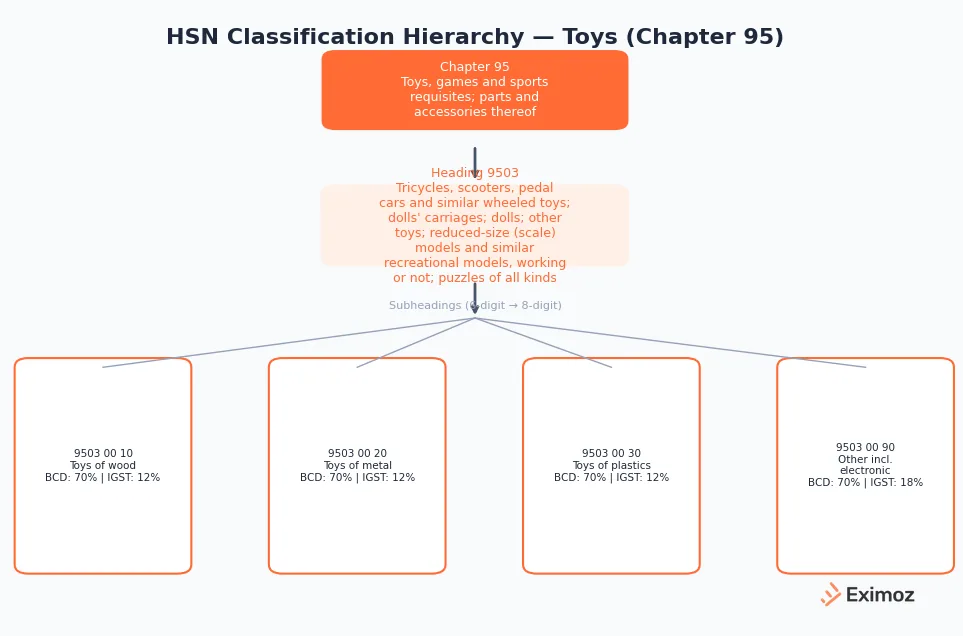
The HSN code for toys in India falls under heading 9503, which is classified by material at the 8-digit level under India's ITC-HS schedule: 9503 00 10 (toys of wood), 9503 00 20 (toys of metal), 9503 00 30 (toys of plastics), and 9503 00 90 (other toys including electronic/battery-operated). The Basic Customs Duty (BCD) on imported toys under heading 9503 is 70%, hiked from 60% in the Union Budget 2023-24. GST is 12% on traditional toys and 18% on electronic/battery-operated toys.
What is the HSN code for toys in India?
Toys in India are classified under Chapter 95 of the Customs Tariff Act, 1975, which covers toys, games, and sports equipment. Within Chapter 95, three headings are relevant:
Heading 9503 is the primary toy classification. It covers all toys, whether stuffed, plastic, wooden, or electronic. Most products that a consumer would call a "toy" fall here. At the 8-digit level, India's ITC-HS schedule breaks 9503 down by what the toy is made of, not what type of toy it is. More on this below.
Heading 9504 covers games, not toys. Board games (9504 90), playing cards (9504 40), and video game consoles like PlayStation, Xbox, and Nintendo Switch (9504 50) all sit under 9504. These have different BCD rates (20%, not 70%) and different regulatory requirements. If you're importing a gaming console and classifying it under 9503, you're using the wrong heading.
Heading 9505 covers festive, carnival, and party articles. Christmas decorations, paper streamers, and similar items go here, not under 9503.
How does India classify toys under heading 9503, by material, not by form?
This is where most importers get tripped up. Internationally, the Harmonized System classifies toys by type: dolls, construction sets, wheeled toys, stuffed animals. India's ITC-HS schedule does it differently. At the 8-digit level, heading 9503 is split by the primary material the toy is made of.
The four sub-headings are:
- 9503 00 10: Toys of wood. Wooden blocks, wooden puzzles, wooden pull-along toys, wooden stacking rings. If the primary material is wood, it goes here regardless of the toy's function.
- 9503 00 20: Toys of metal. Die-cast vehicles, metal construction sets, tin toys. Primary material is metal.
- 9503 00 30: Toys of plastics. Plastic dolls, LEGO-type building sets, plastic ride-on toys, action figures. This is the largest category by volume. A wheeled ride-on toy made of plastic is 9503 00 30 (toys of plastics), not a separate "wheeled toy" code.
- 9503 00 90: Other toys including electronic/battery-operated. RC cars, electronic educational toys, stuffed/textile toys, and anything not classified above by material. This is also the residual sub-heading: if a toy doesn't fit wood, metal, or plastics as its primary material, it lands here.
The determining factor is always the primary material, not the toy's form or function. A wooden puzzle is 9503 00 10. A plastic puzzle is 9503 00 30. Same product type, different HSN codes, because the material differs.
| HSN Code | Product Description | BCD | GST / IGST | BIS Required | Notes |
|---|---|---|---|---|---|
| 9503 00 10 | Toys of wood | 70% | 12% | Yes | Wooden blocks, puzzles, pull-along toys |
| 9503 00 20 | Toys of metal | 70% | 12% | Yes | Die-cast vehicles, metal construction sets |
| 9503 00 30 | Toys of plastics | 70% | 12% | Yes | Plastic dolls, LEGO-type sets, ride-on toys, action figures |
| 9503 00 90 | Other toys incl. electronic/battery-operated | 70% | 18% | Yes | RC toys, electronic educational toys, stuffed toys. May also need CRS compliance |
| 9504 90 | Board games | 20% | 12% | Yes | Falls under heading 9504 (games), not 9503 (toys) |
| 9504 50 | Video game consoles | 20% | 18% | No | PlayStation, Xbox, Nintendo. NOT toys. Different BCD rate |
| 9504 40 | Playing cards | 20% | 18% | No | Falls under heading 9504 (games), not 9503 (toys) |
Source: CBIC Customs Tariff Schedule, Chapter 95. BCD rates as per Finance Act 2023.
What customs duty and GST apply to toy imports?
The 70% BCD on toys under heading 9503 is one of the highest duty rates in India's tariff schedule. This rate was increased from 60% in the Union Budget 2023-24 (Finance Act 2023), continuing a series of hikes that started at 20% before 2020. The stated goal was to push domestic toy manufacturing under the Aatmanirbhar Bharat initiative, and it worked: India went from importing over 80% of its toys (primarily from China) to building significant domestic production capacity.
GST rates split by material classification:
- Traditional toys (9503 00 10, 9503 00 20, 9503 00 30): 12% GST
- Electronic/battery-operated toys (9503 00 90): 18% GST
- IGST on imports mirrors these rates: 12% or 18%
Worked example for a traditional toy import:
CIF value of a plastic toy shipment: ₹10,00,000
BCD at 70%: ₹7,00,000
Social Welfare Surcharge (10% of BCD): ₹70,000
IGST at 12% on (CIF + BCD + SWS): 12% of ₹17,70,000 = ₹2,12,400
Total duty: ₹9,82,400 (approximately 98.24% of CIF value)
For electronic toys (9503 00 90), the IGST goes up to 18%, pushing total landed cost even higher.
Heading 9504 has a different rate. Board games (9504 90), playing cards (9504 40), and video game consoles (9504 50) attract 20% BCD, not 70%. This distinction matters for importers who deal in both toys and games. Misclassifying a board game under 9503 means paying 70% BCD instead of 20%.
Is BIS certification mandatory for importing toys into India?
Yes. Since January 2021, under the Quality Control Order (QCO) for Toys, 2020, all toys sold in India must comply with Indian safety standards IS 9873 (the 9 parts of IS 9873) and IS 15644 (safety of electric toys). This applies to both domestic manufacturers and importers.
What this means in practice for importers:
- Every toy shipment must carry a valid BIS Standard Mark.
- The importer or foreign manufacturer must hold a BIS licence for the specific product.
- Samples must be tested at a BIS-recognised laboratory before the licence is granted.
- Customs will check for BIS compliance at the port. Non-compliant shipments are rejected or destroyed.
Dual compliance for electronic toys (9503 00 90): Electronic and battery-operated toys may also need registration under MeitY's Compulsory Registration Scheme (CRS) for their electronic components, batteries, and chargers. This is separate from BIS toy safety certification. An RC car with a lithium battery and USB charger, for example, needs BIS QCO 2020 certification for the toy itself and CRS registration for the battery and charger. Missing either one can result in customs rejection.
Importers bringing in electronic toys should check CRS applicability early in the sourcing process. Adding CRS registration after the shipment has already left the factory creates delays that BIS certification alone won't solve.
What are common toy classification mistakes at customs?
Classifying by form instead of material. The most common toy classification mistake in India is classifying by form (e.g., 'wheeled toy') instead of material (e.g., 'plastic') as required by heading 9503. If it's a plastic wheeled toy, it's 9503 00 30. If it's a metal wheeled toy, it's 9503 00 20. The function doesn't change the code.
Confusing toys (9503) with games (9504). A children's board game is 9504 90, not 9503. A video game console is 9504 50. The BCD difference is massive: 20% vs 70%. Getting this wrong in either direction creates problems, either overpaying duty or triggering a reassessment notice.
Applying the wrong GST rate. Traditional toys attract 12% GST. Electronic/battery-operated toys attract 18%. Some importers apply 12% across the board and face GST demand notices later.
Ignoring CRS for electronic toys. Clearing a battery-operated toy with BIS certification alone and missing the CRS requirement for the electronic components. Customs may clear the shipment initially, but a post-clearance audit can flag the gap.
Misclassifying educational toys. "Educational" doesn't change the HSN code. A plastic STEM kit is still 9503 00 30 (toys of plastics). A battery-operated educational robot is still 9503 00 90. There is no separate HSN code or concessional GST rate for educational toys. However, educational charts and maps for children fall under Chapter 49 (printed matter) at 12% GST, not Chapter 95.
Frequently Asked Questions
What is the customs duty on importing toys into India?
India imposes 70% Basic Customs Duty on most toy imports under heading 9503. IGST applies at 12% for traditional toys or 18% for electronic/battery-operated toys (9503 00 90). The BCD was increased from 60% to 70% in the Union Budget 2023-24 (Finance Act 2023) to promote domestic manufacturing. The effective landed cost for a traditional toy import is approximately 98% of CIF value when you include BCD, Social Welfare Surcharge, and IGST.
Is BIS certification mandatory for toys in India?
Yes. Since January 2021, all toys sold in India, whether imported or domestically manufactured, must comply with IS 9873 (Parts 1-9) and IS 15644 under the Quality Control Order for Toys, 2020. A BIS licence is mandatory, and imported toys must carry the BIS Standard Mark. Non-compliant toys are rejected at customs. This applies to all toys under HSN 9503 and 9504.
What is the HSN code for electronic toys?
Electronic and battery-operated toys are classified under HSN 9503 00 90 ("other toys, including electronic/battery-operated") and attract 18% GST, higher than the 12% on traditional toys. If a product is primarily a gaming console (PlayStation, Xbox, Nintendo Switch), it falls under 9504 50 (video games), not 9503. Electronic toys under 9503 00 90 may also require CRS registration under MeitY for their electronic and battery components, in addition to BIS toy safety certification.
How are board games and puzzles classified?
Board games fall under HSN 9504 90 (articles for parlour, table, or other games) with 20% BCD and 12% GST. Playing cards are under 9504 40 with 20% BCD and 18% GST. Puzzles, however, are classified under 9503, with the 8-digit code determined by primary material: a wooden puzzle is 9503 00 10, a plastic puzzle is 9503 00 30. The distinction matters because 9503 attracts 70% BCD while 9504 attracts 20%.
What is the GST rate on educational toys?
Educational toys that are traditional (non-electronic) attract 12% GST under heading 9503, the same as other non-electronic toys. Electronic or battery-operated educational toys (classified under 9503 00 90) attract 18% GST. There is no separate concessional GST rate for educational or STEM toys. Educational charts and maps for children are classified under Chapter 49 (printed matter) at 12% GST, not under Chapter 95.
Getting toy classification right is harder than it looks, especially with India's material-based sub-headings, the 70% BCD, mandatory BIS certification, and potential CRS requirements for electronic toys. Eximoz automates the classification process, identifying the correct 8-digit HSN code based on material composition, flagging BIS and CRS compliance requirements, and calculating duty before the shipment reaches the port. If your team handles toy imports at any volume, it's worth a look: eximoz.com