
The HSN code for fertilizer in India falls under Chapter 31, with urea classified as 3102 10, DAP (Di-ammonium Phosphate) as 3105 30, NPK complex fertilizers as 3105 20, and organic fertilizers as 3101. The GST rate on all fertilizers is 5%, and most fertilizer imports enjoy concessional customs duty rates given India's food security priorities.
What is the HSN code for different types of fertilizers in India?
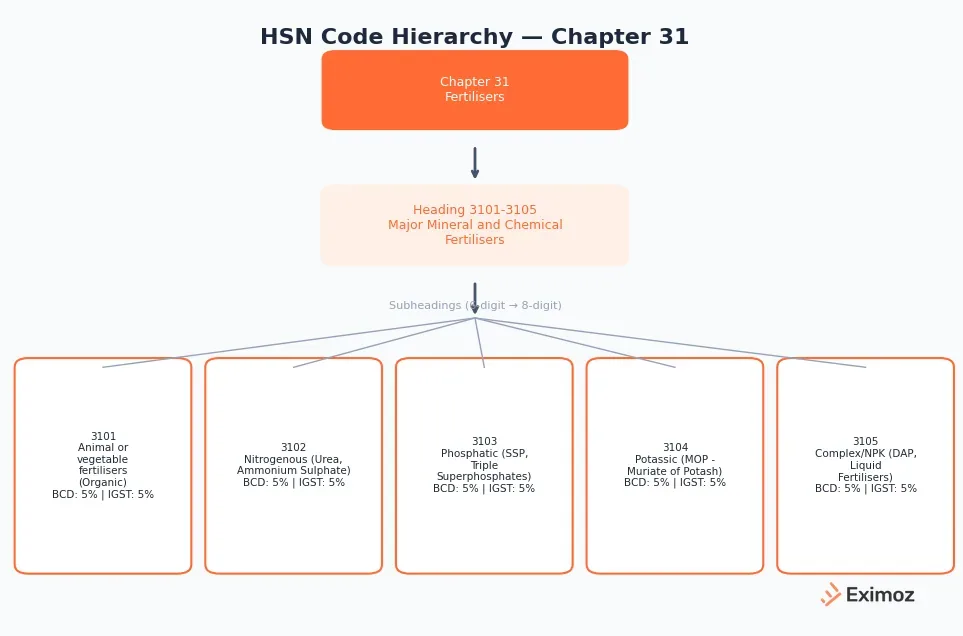
All fertilizers in India are classified under Chapter 31 of the Customs Tariff Act, 1975. Chapter 31 covers mineral and chemical fertilizers along with animal and vegetable-origin organic fertilizers. Here is how the structure breaks down:
- 3101: Organic fertilizers (animal or vegetable origin, including guano, compost, vermicompost, neem cake)
- 3102: Nitrogenous fertilizers (urea, ammonium sulphate, ammonium nitrate, calcium nitrate)
- 3103: Phosphatic fertilizers (single superphosphate/SSP, superphosphates)
- 3104: Potassic fertilizers (MOP/Muriate of Potash, SOP/Sulphate of Potash)
- 3105: Complex and NPK fertilizers (DAP, NPK mixtures, mixed fertilizers)
The first four digits of the HSN code identify the heading, and the remaining digits narrow down the specific product. For example, 3102 10 is urea, while 3102 21 covers ammonium sulphate.
How is urea classified and what are its import duties?
Urea falls under HSN code 3102 10, described as "urea, whether or not in aqueous solution." It is India's most consumed fertilizer, and the country imports large quantities annually from Oman, Saudi Arabia, and China to bridge the gap between domestic production and demand.
The import duties on urea are:
- BCD (Basic Customs Duty): 5%
- IGST: 5%
- GST: 5%
Urea imports in India are canalized, meaning only government-authorized agencies (like RCF, MMTC, IPL, and STC) can import urea. The canalization policy ties into the government's fertilizer subsidy and price control system. Domestically, all urea must be neem-coated as per government mandate, which applies to both imported and locally manufactured stock.
What HSN codes apply to DAP, MOP, and complex fertilizers?
DAP, MOP, and NPK complex fertilizers each have distinct HSN codes under Chapter 31. The full classification and duty rate table:
| Fertilizer Type | HSN Code | BCD Rate | IGST Rate | GST Rate | Subsidy |
|---|---|---|---|---|---|
| Urea | 3102 10 | 5% | 5% | 5% | Yes |
| Ammonium sulphate | 3102 21 | 5% | 5% | 5% | Yes |
| DAP | 3105 30 | 5% | 5% | 5% | Yes |
| MOP/Potash | 3104 20 | 5% | 5% | 5% | Yes |
| NPK complex | 3105 20 | 5% | 5% | 5% | Yes |
| SSP | 3103 10 | 5% | 5% | 5% | Yes |
| Ammonium nitrate | 3102 30 | 5% | 5% | 5% | Yes |
| Calcium nitrate | 3102 60 | 5% | 5% | 5% | Yes |
| Organic fertilizer | 3101 00 99 | 5% | 5% | 5% | Limited |
| Bio-fertilizer | 3101/3808 | 5% | 5% | 5% | Limited |
India is one of the world's largest importers of DAP, bringing in over 5 million tonnes annually. The government provides per-tonne subsidies on DAP (approximately ₹21,676 per tonne) to keep retail prices affordable for farmers. MOP is entirely imported since India has no potash reserves, so getting the classification and duty payment right on potash shipments matters more than usual.
What is the GST rate on fertilizers in India?
All fertilizers in India attract a flat 5% GST rate. It covers chemical fertilizers under Chapter 31, organic fertilizers, and bio-fertilizers alike. The 5% rate was set to keep agricultural input costs low for Indian farmers.
However, this creates an inverted duty structure. Many raw materials used in fertilizer manufacturing attract 18% GST. Sulphuric acid (HSN 2807) and phosphoric acid (HSN 2809), both key inputs, fall in the 18% bracket. In practice, manufacturers pay more GST on inputs than they collect on outputs.
To address this, fertilizer manufacturers can claim refunds on the accumulated input tax credit (ITC) through the GST refund mechanism. Before GST, fertilizers were subject to a patchwork of excise duty, VAT, and entry taxes that varied by state. The uniform 5% GST rate made things simpler.
How are organic and bio-fertilizers classified under HSN?
Organic fertilizers are classified under HSN heading 3101, which covers fertilizers of animal or vegetable origin. The sub-classifications are:
- 3101 00 10: Guano
- 3101 00 91: Animal-origin fertilizers (bone meal, dried blood, fish waste)
- 3101 00 99: Vegetable-origin organic fertilizers (compost, vermicompost, neem cake)
Bio-fertilizers present a classification challenge. Products containing live microorganisms (like Rhizobium, Azotobacter, or Phosphate Solubilizing Bacteria) may fall under 3101 if marketed as fertilizers, or under 3808 if they are formulated more like plant growth regulators or biocides.
India's push toward organic farming under the PM-PRANAM scheme and the National Programme for Organic Production (NPOP) has increased the volume of organic fertilizer imports. If you are importing organic or bio-fertilizers, confirm the exact sub-heading with your customs broker based on the product composition and labelling.
Fertilizer imports come with concessional duties, subsidy paperwork, and exemption notifications that shift with each budget cycle. Eximoz tracks the latest applicable duty rate for every Chapter 31 heading so you always import at the correct concessional rate. Try Eximoz to automate your fertilizer classification and duty calculations.
Frequently Asked Questions
What is the HSN code for urea fertilizer?
Urea is classified under HSN 3102 10, which covers urea whether in solid or aqueous solution form. It falls under Chapter 31, heading 3102 for nitrogenous mineral or chemical fertilizers. The BCD on urea is 5% and GST is 5%.
What is the customs duty on DAP fertilizer imports?
DAP (Di-ammonium Phosphate) under HSN 3105 30 attracts 5% BCD and 5% IGST. India imports over 5 million tonnes of DAP each year, and the government provides per-tonne subsidies to keep retail prices manageable for farmers.
What is the GST rate on fertilizers?
All fertilizers attract 5% GST in India, whether chemical, organic, or bio-fertilizer. Some fertilizer raw materials like sulphuric acid and phosphoric acid attract 18% GST, creating an inverted duty structure. Manufacturers can recover the difference through ITC refund claims.
What is the HSN code for organic fertilizer?
Organic fertilizers fall under HSN 3101, specifically 3101 00 99 for vegetable-origin products like compost, vermicompost, and neem cake. Animal-origin fertilizers such as bone meal and fish waste are classified under 3101 00 91. Bio-fertilizers containing live microorganisms may fall under 3101 or 3808 depending on formulation.
Can fertilizer imports get customs duty exemptions in India?
Yes, the government regularly issues customs duty exemptions on fertilizer imports through notifications under Section 25 of the Customs Act. Urea imports by designated government agencies can attract nil BCD, and some FTA partners enjoy reduced rates. These exemptions change based on agricultural season and domestic supply conditions.
Sources:
- CBIC Customs Tariff, Chapter 31
- Department of Fertilizers, Ministry of Chemicals
- GST Rate Schedule