

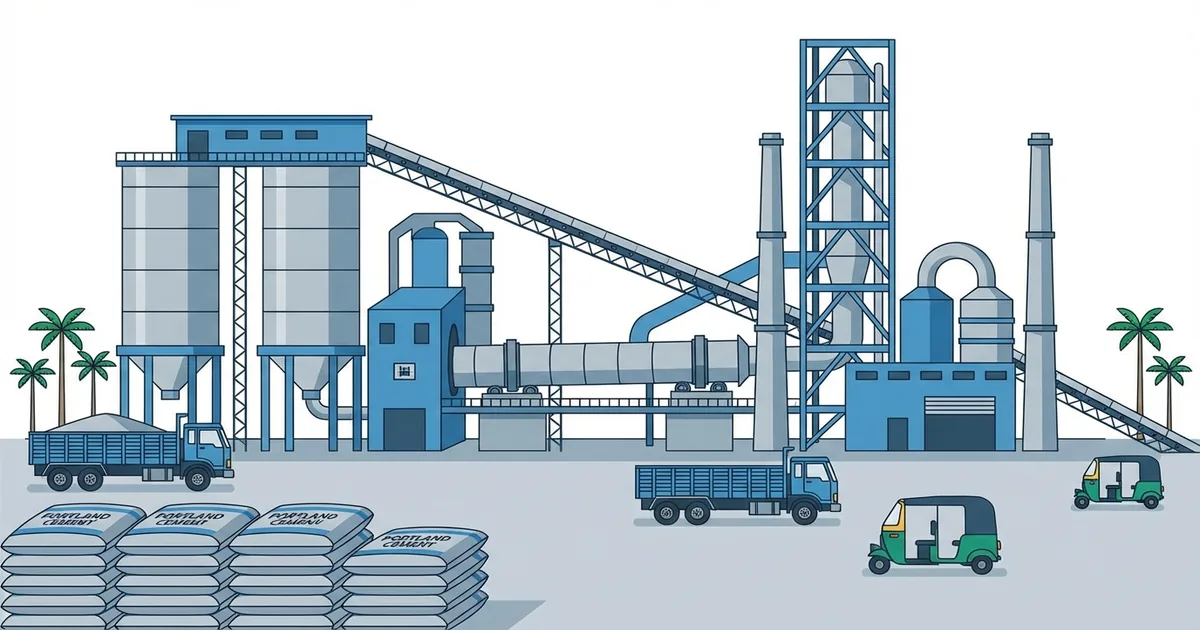
The HSN code for cement in India is 2523, covering Portland cement, aluminous cement, slag cement, and cement clinkers, with a GST rate of 18% effective from September 2025.
Whether you're filing GST returns, raising import documentation, or classifying cement for export, you need the right HSN code. This guide breaks down every cement subheading under Chapter 25 of the Customs Tariff, along with applicable GST and customs duty rates, sourced from CBIC's official Customs Tariff and the GST Rate Schedule.
What is the HSN code for cement in India?
HSN code 2523 is the 4-digit heading that covers all hydraulic cements under the Harmonized System of Nomenclature. This heading sits within Chapter 25 (Salt; sulphur; earths and stone; plastering materials, lime and cement) of the Indian Customs Tariff.
The five sub-codes under 2523 are:
-
2523 10 — Cement clinkers
-
2523 21 — White Portland cement
-
2523 29 — Other Portland cement (including OPC and PPC)
-
2523 30 — Aluminous cement
-
2523 90 — Other hydraulic cements (including slag cement / PSC)
For GST invoicing, businesses with a turnover above ₹5 crore must declare at least a 6-digit HSN code. For import and export documentation (Bills of Entry, Shipping Bills, and Letters of Credit), the full 8-digit code is mandatory.
What GST rate applies to cement under HSN 2523?
Cement across all sub-codes under HSN 2523 attracts 18% GST as of September 2025. This is down from the earlier 28% rate, following the GST 2.0 reforms introduced to reduce construction costs across India.
The 18% rate applies uniformly to:
-
Cement clinkers (2523 10)
-
White Portland cement (2523 21)
-
OPC, PPC, and other Portland cements (2523 29)
-
Aluminous cement (2523 30)
-
Slag cement, PSC, and other hydraulic cements (2523 90)
ITC impact: Manufacturers and dealers can claim full Input Tax Credit on cement purchases used in taxable supplies. For construction companies, this rate reduction combined with ITC eligibility has brought down project costs. The GST Council estimated a 3-4% drop in overall cement procurement costs following the reform (source: cbic-gst.gov.in).
How do I classify different types of cement using HSN codes?
Each cement type maps to a specific HSN sub-code. Here's the breakdown:
| Cement Type | HSN Code | GST Rate | Customs Duty (BCD) |
|---|---|---|---|
| Portland Cement (OPC) | 2523 29 | 18% | 10% |
| White Portland Cement | 2523 21 | 18% | 10% |
| Cement Clinkers | 2523 10 | 18% | 10% |
| Aluminous Cement | 2523 30 | 18% | 10% |
| Slag Cement (PSC) | 2523 90 | 18% | 10% |
Portland Pozzolana Cement (PPC), the most widely used cement in India, falls under 2523 29 alongside OPC and rapid hardening cement. The HSN classification is based on chemical composition and binding properties, not on brand or commercial name.
Rapid Hardening Cement also classifies under 2523 29, as it is a variant of Portland cement with a finer grind and higher C₃S content.
All rates in the table above are sourced from the CBIC Customs Tariff (taxinformation.cbic.gov.in) and the GST Rate Schedule, Chapter-wise Rate-wise GST Schedule (cbic-gst.gov.in/pdf/chapter-wise-rate-wise-gst-schedule-18.05.2017.pdf), as amended by subsequent notifications.
What is the customs duty on cement imports to India?
Importing cement into India attracts multiple layers of duty:
-
Basic Customs Duty (BCD): 10% across all cement types under HSN 2523
-
Social Welfare Surcharge (SWS): 10% of BCD (effectively 1% of assessable value)
-
IGST: 18% on the assessable value plus BCD and SWS
The effective duty on imported cement works out to approximately 30.98%. To understand the full breakdown, use our import duty calculator.
No anti-dumping duties are currently in force on cement imports from any origin as of March 2026. That said, importers should check the latest DGTR notifications before placing orders, since anti-dumping investigations can come up at short notice.
For exports, cement classified under HSN 2523 is not subject to any export duty and is eligible for standard export incentive schemes.
How does Eximoz simplify cement HSN classification?
Classifying cement products by hand means cross-referencing Chapter 25 of the Customs Tariff, checking GST rate notifications, and figuring out whether a product falls under 2523 29 or 2523 90, a distinction that depends on chemical composition rather than trade name.
Eximoz's AI-powered HSN classifier does this for you. Paste a product description and get the exact 8-digit HSN code, GST rate, and customs duty in seconds.
Try the Eximoz HSN Classifier →
Frequently asked questions
What is the HSN code for cement bags?
HSN 2523 29 covers Portland cement regardless of packaging, whether sold in 50kg bags, jumbo bags, or bulk tankers. Packaging does not change the HSN classification; the product is still classified under Chapter 25 based on its composition.
Is cement taxed at 18% or 28% GST in 2026?
As of September 2025, cement is taxed at 18% GST, reduced from the earlier 28% rate under the GST 2.0 reforms. This applies to all cement types under HSN 2523. The change was introduced via an amendment to Notification 1/2017-Central Tax (Rate).
What is the HSN code for ready-mix concrete?
Ready-mix concrete (RMC) falls under HSN 3824 50, not under 2523. RMC is a prepared product classified under Chapter 38 (Miscellaneous chemical products) and attracts 18% GST. Do not confuse it with cement as a raw material.
What is the difference between HSN 2523 and 6810?
HSN 2523 covers cement as a raw material, in powder or clinker form. HSN 6810 covers finished articles made of cement, such as concrete bricks, blocks, tiles, pipes, and prefabricated structural components. The distinction matters for both GST invoicing and customs classification.
Do I need an 8-digit HSN code for cement on GST invoices?
Businesses with annual turnover above ₹5 crore must use at least a 6-digit HSN code on GST invoices. The full 8-digit code is not mandatory for domestic GST invoicing but is required for all import and export documentation, including Bills of Entry, Shipping Bills, and IGST refund claims.