
The HSN code for cable in India falls under Chapter 85 heading 8544, with electrical wires classified under 8544 49, fibre-optic cables under 8544 70, and coaxial cables under 8544 20. Most cable types attract 18% GST, and Basic Customs Duty (BCD) ranges from 7.5% to 10% depending on the specific sub-heading.
What is the HSN code for cable in India?
Heading 8544 covers all insulated electrical conductors and optical-fibre cables. To find your exact six- or eight-digit code, you need to know three things: what the conductor carries (electricity vs. optical signals), the voltage rating, and whether it has connectors or specialized construction like enameling.
You have to declare the full eight-digit code for customs filing. GST returns usually accept six digits, but giving all eight up front keeps you out of mismatch notice territory.
How are different types of cables classified under HSN?
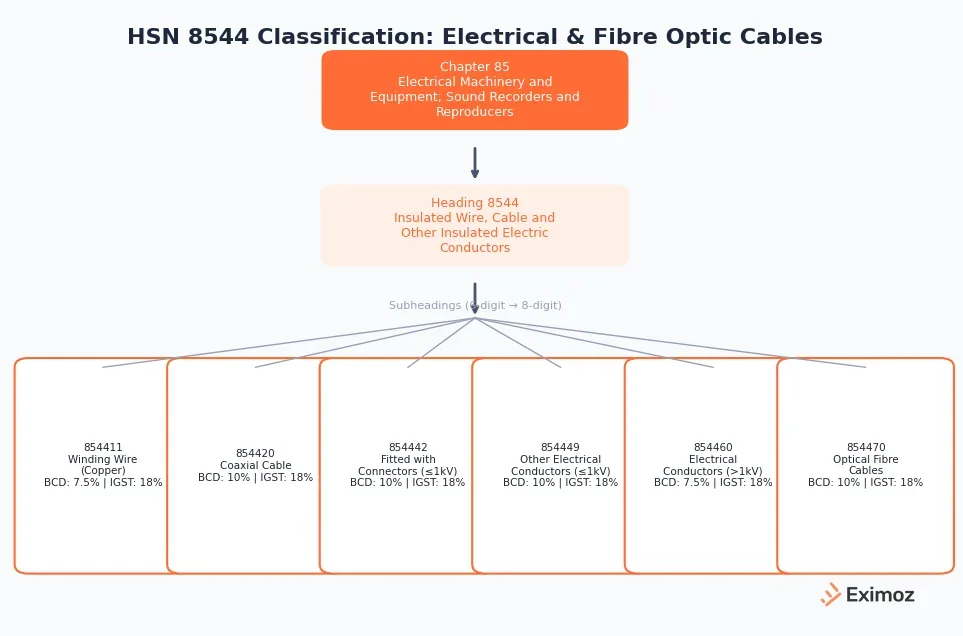
| Cable type | 8-digit HSN code | BCD (%) | IGST (%) | BIS required? |
|---|---|---|---|---|
| Electrical wire fitted with connectors, ≤ 1 kV | 8544 42 00 | 10 | 18 | Yes – IS 694 / IS 1554 |
| Other electrical cable, ≤ 1 kV | 8544 49 10 / 90 | 10 | 18 | Yes – IS 694 / IS 7098 |
| High-voltage power cable (> 1 kV) | 8544 60 00 | 7.5 | 18 | Yes – IS 7098-II/III |
| Coaxial cable | 8544 20 00 | 10 | 18 | No |
| Fibre-optic cable, individually sheathed fibres | 8544 70 10 | 10 | 18 | No |
| Fibre-optic cable, other | 8544 70 90 | 10 | 18 | No |
| Winding/enamelled wire | 8544 11 00 | 7.5 | 18 | No |
| Bare copper strand (not insulated) | 7413 00 00 | 5 | 18 | No |
A few quick rules of thumb:
- Insulation is the deciding factor. Bare metal strands get kicked over to Chapter 74.
- USB, HDMI, and similar data cables with moulded connectors belong in 8544 42.
- Don't go looking for a solar-specific heading for solar DC cables – they stay in 8544.
What customs duty applies to cable imports in India?
Most insulated cables attract 10% BCD, though high-voltage power cables get a slight break at 7.5%. You also have to calculate the 10% Social Welfare Surcharge (SWS) on the BCD amount. IGST sits at 18% and applies to the cumulative assessable value after BCD and SWS.
Watch out for Countervailing Duty (CVD). If you're importing certain optical-fibre and telecom cables from specific countries, CBIC safeguard notifications might hit you with extra duties. It pays to check the anti-dumping lists before you file.
Duty calculation example: Import of PVC-insulated electrical cable (HSN 8544 49 10) with a CIF value of ₹5,00,000:
- BCD 10%: ₹50,000
- SWS 10% of BCD: ₹5,000
- Sub-total for IGST: ₹5,55,000
- IGST 18%: ₹99,900
- Total duty payable: ₹1,54,900
Is BIS certification required for importing cables into India?
Usually, yes. Before you can clear customs, most electrical cables have to meet specific Indian Standards:
- IS 694: PVC-insulated cables up to and including 1 kV
- IS 1554: Rubber-insulated flexible cables
- IS 7098: Cross-linked polyethylene (XLPE) power cables (> 1 kV)
The manufacturer abroad needs a valid BIS FMCS licence, and as the importer, you need to make sure their Registration Number is actually printed on the product labels. Don't forget to upload the test reports to ICEGATE.
What are common cable misclassification mistakes?
We see a few recurring errors when teams classify cables:
- Treating USB/HDMI leads as computer parts (8473): Even if it connects to a computer, an insulated conductor with connectors stays in 8544 42.
- Dumping fibre bundles into optical glass (9001 10): That heading is strictly for unassembled fibres. Finished fibre-optic cables belong in 8544 70.
- Inventing a solar category (8541): There is no specific carve-out for solar DC cables under the solar module heading. Keep them right where they are in 8544.
- Classifying bare copper rope as insulated: If it doesn't have dielectric insulation, it's just metal. Send it to Chapter 74 (7413).
Frequently Asked Questions
Q1. What is the HSN code for electrical wire and cable in India?
Electrical wires and cables generally fall under heading 8544. For voltages up to 1 kV, use 8544 42 if they have connectors, or 8544 49 if they don't. Both take 18% GST and 10% BCD.
Q2. What is the HSN code for fibre-optic cable?
Fibre-optic cables go under 8544 70. Use 8544 70 10 if every single fibre is individually sheathed. If not, use 8544 70 90. The duty rate is the same for both: 10% BCD and 18% GST.
Q3. What is the HSN code for HDMI or USB cables?
HDMI, USB, and similar data leads with connectors fall under 8544 42 00, which covers insulated wire with connectors up to 1 kV. Expect an 18% GST and 10% BCD.
Q4. What is the difference between HSN 8544 and 7413 for copper cables?
It all comes down to insulation. Heading 8544 is for insulated electrical conductors built to carry current. Heading 7413 is for bare, non-insulated stranded copper wire used for mechanical purposes.
Q5. Do I need BIS certification to import cables into India?
Usually, yes. You need mandatory BIS certification for PVC, rubber, and XLPE insulated power cables. Fibre-optic and coaxial cables don't currently require it, though you should always verify recent BIS notifications just in case.
Conclusion
If you're clearing hundreds of cable shipments a month, looking up voltages and insulation types gets tedious fast. We built Eximoz to run those checks automatically. It assigns the right eight-digit HSN code, flags BIS requirements before the shipment reaches the port, and catches duty concessions you might have missed. See how it works at eximoz.com.