

DGFT Notification No. 03/2026-27 dated April 2, 2026 restricts imports of gold, silver, and precious metal articles under Chapter 71 of ITC (HS) 2022 with immediate effect. Items previously classified as "Free" now require an import license from DGFT. No transitional relief is available for goods already in transit.
What changed in India's gold and precious metal import policy in April 2026?
On April 2, 2026, DGFT issued Notification No. 03/2026-27 under Sections 3 and 5 of the FTDR Act, 1992. The notification moved multiple items under Chapter 71 of ITC (HS) 2022 from "Free" to "Restricted" import policy.
What changed: a new Policy Condition No. 7 has been added to Chapter 71. Any item tagged with this condition now needs a valid import license before it can enter India. There is no grace period and no exemption for shipments already on the water.
Why now? India's gold imports surged past $50 billion in FY2025-26 after BCD was cut from 15% to 6% in the July 2024 Budget. The duty cut, intended to reduce smuggling and bring gold trade into formal channels, had an unintended side effect. Round-tripping of gold through re-export and re-import channels increased sharply, with traders exploiting the lower duty structure to move gold in and out of India for arbitrage. DGFT had already signalled a tighter approach under the Foreign Trade Policy 2023, which emphasized controlling imports of sensitive commodities at the licensing stage rather than relying solely on tariff barriers.
This notification, paired with Notification 02/2026-27 (restricting jewellery imports under CTH 7113), is a direct move to control gold demand at the import stage. The policy direction is clear: India wants to maintain its jewellery export competitiveness while reducing the volume of gold imported for domestic consumption, resale, and speculative purposes. The customs duty on gold remains at 6% BCD, but the licensing requirement adds a regulatory gate that duty alone could not provide.
Which precious metal items are now restricted under DGFT Notification 03/2026-27?
The affected ITC (HS) codes:
| ITC (HS) Code | Item Description | Old Policy | New Policy | Condition |
|---|---|---|---|---|
| 7109 0000 | Base metals or silver, clad with gold (semi-manufactured) | Free | Restricted | Policy Condition 7 |
| 7110 11 19 | Platinum, unwrought (other) | Restricted | Free | Gold content >1% remains Restricted |
| 7110 11 29 | Platinum powder (other) | Restricted | Free | Gold content >1% remains Restricted |
| 7110 19 90 | Platinum, other forms | Restricted | Free | Gold content >1% remains Restricted |
| 7111 0000 | Base metals, silver, or gold clad with platinum | Free | Free | Silver/Gold content >1% = Restricted |
| 7114 11 10 | Silver articles of goldsmiths' wares | Free | Restricted | Policy Condition 7 |
| 7114 11 20 | Silver parts of goldsmiths' wares | Free | Restricted | Policy Condition 7 |
| 7114 19 10 | Gold articles of goldsmiths' wares | Restricted | Restricted | Policy Condition 7 |
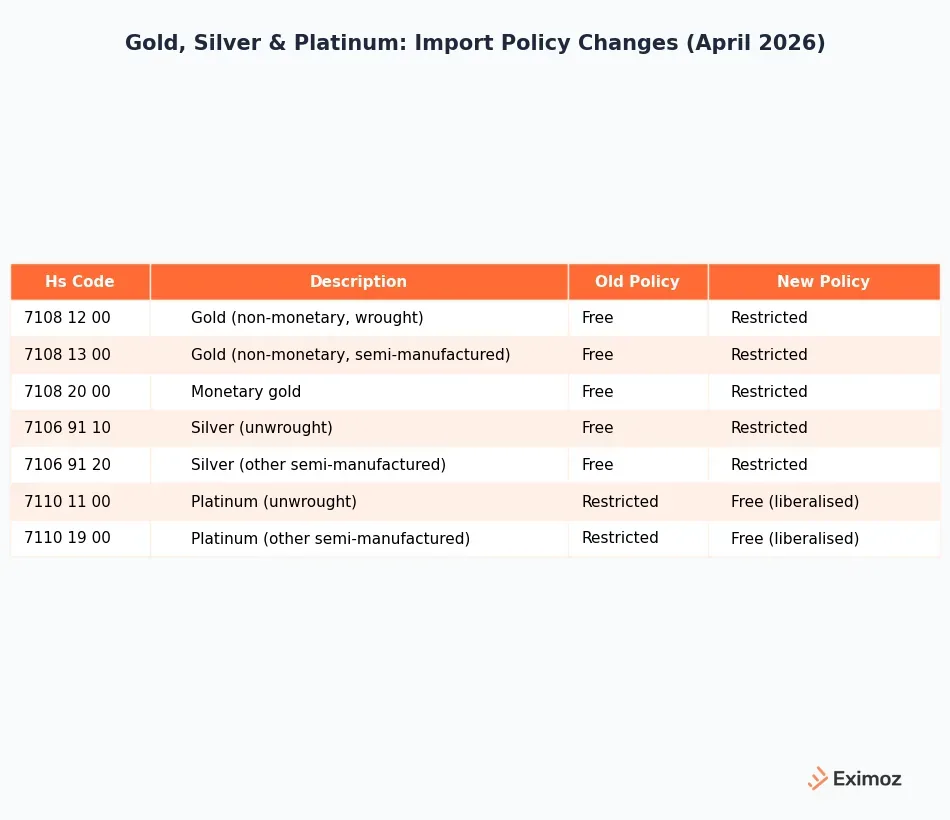
Platinum imports, however, have been partially liberalised. Unwrought platinum and platinum powder moved from "Restricted" to "Free." But if the platinum alloy contains more than 1% gold by weight, it stays restricted. This blocks a potential workaround where gold could enter India disguised as a platinum alloy.
For importers dealing with jewellery and precious metal articles, cross-check the ITC (HS) code of your specific product against both this notification and Notification 02/2026-27. Some items under Chapter 71 overlap in scope, and using the wrong code can create clearance problems at the port.
Are EOU and SEZ units exempt from the new gold import restrictions?
Yes, with conditions. Policy Condition No. 7 provides exemptions for three categories:
- 100% Export Oriented Units (EOUs) importing under Para 6.01(d) of the Foreign Trade Policy 2023.
- SEZ units importing under Rule 27 of the Special Economic Zones Rules, 2006.
- Imports under Gems and Jewellery export promotion schemes covered by Chapter 4 of FTP 2023.
The catch: imported goods must not be diverted to the Domestic Tariff Area (DTA). If an EOU or SEZ unit brings in gold under these exemptions and sells it domestically, the exemption is void and penalties apply.
The government wants to protect India's jewellery export industry while restricting gold imported for domestic consumption, resale, or investment.
What does "no transitional arrangements" mean for importers with goods in transit?
Normally, FTP changes include a transitional period where importers with existing LCs or goods already shipped can complete transactions under old rules. This notification explicitly denies that. Para 5 states that transitional arrangements under FTP 2023 shall not apply.
What this means for you:
- If your gold shipment was already on the water when the notification was issued on April 2, 2026, you still need an import license to clear it.
- If you had an irrevocable LC opened before the notification, it does not matter. The restriction applies.
- If you made advance payments to your supplier, the payment status has no bearing on the import policy.
How should importers with existing orders or LCs handle the transition?
If you have gold or precious metal shipments already contracted, shipped, or backed by an LC opened before April 2, 2026, you need to act immediately. There is no automatic grandfathering.
Your first step is to file a license application with DGFT before the goods arrive at the Indian port. Customs will not release restricted goods without a valid license, regardless of when the purchase contract was signed. If the goods are already at the port and awaiting clearance, contact the DGFT Regional Authority in your jurisdiction directly: Delhi, Mumbai, Chennai, Kolkata, or one of the other regional offices, and request expedited processing. Explain the circumstances and provide the LC details, shipping documents, and a copy of the notification.
If you are an EOU or SEZ unit, verify whether your import falls under the Policy Condition 7 exemptions before filing a license application. If it does, you may not need a license at all, but you will need to provide documentation proving your EOU/SEZ status and confirming that the goods will not enter the DTA.
For importers who cannot obtain a license in time, the practical options are limited. You can request your supplier to hold the shipment at the origin port while the license is processed. Alternatively, goods can be warehoused at the Indian port under a warehousing bond (Section 49 of the Customs Act, 1962), but warehousing charges accumulate quickly and the license must still be obtained before clearance.
What is the process for applying for an import license from DGFT?
The application is filed through the DGFT online portal at dgft.gov.in. Here is the step-by-step process:
-
Log in to your DGFT IEC account. You need an active Importer Exporter Code. If your IEC is suspended or needs updating, fix that first. DGFT will reject license applications tied to non-active IECs.
-
Navigate to "Services" → "License Application" and select the module for restricted goods under Chapter 71.
-
Fill in the application details: Specify the ITC (HS) code (from the table above), quantity, value in USD/INR, country of origin, and the port of import.
-
Upload supporting documents: At minimum, you will need:
- IEC certificate (current)
- Import contract or purchase order
- End-use declaration stating the purpose of the import (manufacturing, export, resale)
- If applicable, EOU/SEZ registration certificate
- Bank-certified copy of the LC (if claiming goods are already contracted)
-
Submit and pay the application fee. The fee is nominal (typically ₹500–1,000 depending on the category).
-
DGFT review: The application goes to the DGFT Regional Authority having jurisdiction over your registered office. For most importers, this is one of: DGFT Delhi (Udyog Bhawan), DGFT Mumbai (Ballard Estate), DGFT Chennai (Shastri Bhawan), DGFT Kolkata (Nizam Palace), or DGFT Bengaluru.
-
Additional queries or end-use undertaking: DGFT may request further documentation or an undertaking that the imported gold will be used for a specific purpose (manufacturing, re-export). Respond promptly. Delays here extend the processing timeline.
-
License issuance: Once approved, the license specifies the permitted quantity, value cap, validity period (typically 12–24 months), and any conditions on end-use or re-export.
For standard restricted items, DGFT targets 3–5 working days for processing. However, expect longer processing times in the first few weeks given the sudden nature of this restriction and the likely surge in applications. Importers filing for the first time under this category should budget 7–10 working days minimum.
If your gold articles also fall under Notification 02/2026-27 (jewellery under CTH 7113), check both notifications to confirm which applies. In some cases, you may need separate licenses for different product categories even within the same shipment.
Frequently Asked Questions
Can I still import gold into India freely after April 2, 2026?
No. DGFT Notification 03/2026-27 has shifted several gold-related items under Chapter 71 from "Free" to "Restricted" import policy. You now need a valid import license from DGFT to import these goods. The restriction applies immediately with no transitional relief.
Does the gold import restriction apply to jewellery as well?
Jewellery is covered under a separate notification. DGFT Notification 02/2026-27 dated April 1, 2026 restricts jewellery imports under CTH 7113. Together, these two notifications tighten imports of gold in all forms: raw, semi-manufactured, and finished jewellery.
Are SEZ units and EOUs exempt from the new precious metal import restrictions?
Yes, partially. Policy Condition No. 7 exempts imports by 100% EOUs and SEZ units under Para 6.01(d) of FTP 2023 and Rule 27 of SEZ Rules 2006, provided the imported goods are not diverted to the Domestic Tariff Area. Imports under Gems and Jewellery export schemes (Chapter 4 of FTP 2023) are also exempt.
What about platinum imports? Are they also restricted?
Platinum imports have been liberalised in certain categories. Unwrought platinum and platinum powder have been moved from "Restricted" to "Free." But platinum alloys with more than 1% gold by weight remain restricted under the same notification.
My gold shipment was already on the water when the notification was issued. Can I still clear it?
No. The notification explicitly denies the benefit of transitional arrangements under FTP 2023. Prior contracts, existing LCs, or advance payments make no difference. You will need an import license from DGFT to clear the goods. File your license application immediately and contact the DGFT Regional Authority in your jurisdiction to request expedited processing.
Import policy changes like this do not come with advance warning. One notification can turn a routine shipment into a compliance problem overnight. Eximoz flags restricted items before you file your Bill of Entry, so your team catches policy changes at the classification stage instead of at the port. Check how it works at eximoz.com.