


A DGFT Certificate of Origin is a certified document that declares where goods were manufactured or produced, issued through authorized agencies operating under the DGFT framework. For Indian exporters claiming preferential tariff benefits under India's Free Trade Agreements, the DGFT-prescribed process determines which agency issues your certificate, what rules of origin documentation you need, and whether you file electronically through the eCoO 2.0 portal or in person. Most DGFT CoO applications are processed within one to two working days.
The eCoO 2.0 portal, launched by DGFT in January 2025, is now the primary digital platform for Indian exporters to file Certificate of Origin applications — replacing and expanding upon the earlier ICEGATE-based e-filing system. The platform processes over 7,000 eCoOs daily and supports both preferential and non-preferential certificates, including the new Back-to-Back CoO mechanism introduced via Public Notice 43/2024-25 dated 27 January 2025. 1
What Is a DGFT Certificate of Origin and How Does It Work?
The DGFT Certificate of Origin answers one question that matters at every border: where were these goods made? That answer controls which tariff rate applies when your shipment enters another country.
In India, the DGFT does not issue CoOs directly. Instead, it authorizes a network of agencies — Chambers of Commerce, Export Promotion Councils, and commodity boards — to issue certificates on its behalf. The DGFT sets the rules, prescribes the formats, and oversees which agencies can certify for which trade agreements. When an authorized agency stamps your CoO, it carries that institutional weight.
The two main categories are preferential and non-preferential. A preferential DGFT Certificate of Origin lets you claim reduced or zero tariffs under India's FTAs — India-ASEAN, India-Japan CEPA, India-Korea CEPA, India-Malaysia CECA, and the India-Australia ECTA. A non-preferential DGFT Certificate of Origin is used for everything else: MFN duty rates, anti-dumping duties, country-of-origin marking rules, and GSP benefits in markets like the EU, US, and Canada.
The DGFT angle matters because the specific form, documentation requirements, and rules-of-origin criteria all trace back to DGFT policy circulars and the trade agreements it administers. Get any of those wrong — the wrong form, the wrong documentation, the wrong agency — and you're looking at a shipment held at the border with unexpected duties attached.
How to Apply for a DGFT Certificate of Origin in India
Indian exporters have two routes: in-person through an authorized agency, or electronically through the eCoO 2.0 portal.
Route 1: In-Person Application Through an Authorized Agency
Identify the right agency. Under the DGFT framework, CoOs are issued by agencies it designates. These include:
- Federation of Indian Chambers of Commerce and Industry (FICCI), New Delhi
- Confederation of Indian Industry (CII), New Delhi
- Export Promotion Councils: EEPC India for engineering goods, APEDA for agricultural products, CAPEXIL for chemicals, and others by product category
- Regional Chambers of Commerce in Mumbai, Kolkata, Chennai, Ahmedabad, Bangalore, and other trade cities
- Port-specific agencies including the Mumbai Chamber of Commerce and Industry and the Calcutta Chamber of Commerce
Your product category and your export destination both determine which agency to approach. If you are exporting engineering goods to a ASEAN country under the India-ASEAN FTA, EEPC India is likely your agency. If you are exporting chemicals to Canada under GSP, a regional chamber of commerce handles it.
Gather the required documents. The standard set for a DGFT CoO application is:
- Application form — agency-specific, available on the chamber or EPC website
- Commercial invoice showing FOB or CIF value
- Packing list itemising the shipment contents
- Certificate of manufacturing or processor declaration confirming where goods were produced
- Bill of Lading or Airway Bill once available
- Fee payment — typically between Rs. 500 and Rs. 5,000 per certificate depending on the agency, number of items, and urgency
For a preferential DGFT CoO, additional requirements apply: the relevant trade agreement form (Form A or equivalent under the specific FTA), rules-of-origin evidence such as a bill of materials or manufacturing process sheet, and sometimes a manufacturer's declaration confirming local content percentages.
Submit, pay, and collect. Standard processing takes one to two working days. Most chambers offer same-day or 24-hour rush processing for an additional fee, which matters when a shipment is waiting on documentation before a vessel sails.
Route 2: Electronic Filing Through the eCoO 2.0 Portal
The eCoO 2.0 portal at coo.dgft.gov.in is DGFT's official digital platform for Certificate of Origin filing. It supersedes the earlier ICEGATE-based e-filing system and supports both preferential and non-preferential CoO applications. The exporter manual provides detailed step-by-step guidance. 2
Here is how the electronic route works:
- Register at coo.dgft.gov.in using your DGFT-issued Importer-Exporter Code (IEC)
- Navigate to the e-CoO application section
- Fill in exporter details, HS code, destination country, and whether you are claiming preferential or non-preferential treatment
- Upload supporting documents: commercial invoice, packing list, and manufacturing declaration
- Submit and pay the fee electronically
- Track application status online through the portal dashboard
From 1 January 2025, non-preferential CoO applications must be filed exclusively through the eCoO 2.0 portal. Preferential CoO applications for FTAs are also filed through the same platform. For preferential applications involving detailed rules-of-origin documentation — particularly under FTAs with percentage-based local content requirements — many exporters still work with their Chamber of Commerce certification officer who can review the bill of materials directly via the portal.
What's New in 2026? DGFT eCoO 2.0 Updates Indian Exporters Need to Know
The eCoO 2.0 portal, launched by DGFT in January 2025, represents the most significant upgrade to India's Certificate of Origin filing infrastructure in years. Here is what exporters need to know about the changes:
Mandatory eCoO 2.0 for Non-Preferential CoOs from January 2025. From 1 January 2025, all non-preferential DGFT CoO applications must be filed through the eCoO 2.0 portal. This applies to certificates used for MFN duty declarations, anti-dumping filings, country-of-origin marking, and GSP applications in markets like the EU, US, and Canada. Exporters still using legacy ICEGATE-based processes for non-preferential certificates need to transition immediately.
Back-to-Back CoO — Public Notice 43/2024-25. Public Notice 43/2024-25 dated 27 January 2025 introduced the Back-to-Back CoO mechanism, enabling exporters who export components or intermediates to another country (for further manufacturing) to claim a CoO based on the origin of those intermediates. This is particularly relevant for exporters operating within global value chains — for example, an Indian manufacturer exporting steel components to a Vietnam facility for assembly before final export to the US can now obtain a Back-to-Back CoO proving Indian origin for the value added in India. See the dedicated section below for full details.
2F Approved Exporter System. The 2F Approved Exporter System allows pre-approved exporters to self-certify the origin of their goods without requiring pre-clearance verification by a certification agency. This significantly reduces processing time for high-volume exporters who meet DGFT's approved exporter criteria.
Scale of adoption. The eCoO 2.0 portal is now processing over 7,000 certificates daily, indicating broad adoption across India's export community. 1
Preferential vs Non-Preferential DGFT Certificate of Origin
This is the distinction that causes the most confusion and the most costly errors.
| Preferential DGFT CoO | Non-Preferential DGFT CoO | |
|---|---|---|
| Purpose | Claim FTA tariff benefits | MFN duty, anti-dumping, GSP labelling |
| Trade agreement required | Yes — must specify which FTA | No — applies universally |
| Rules of origin | Must be satisfied with documentation | Simple declaration of origin |
| Form | Agreement-specific (e.g., Form A under India-ASEAN) | Standard format |
| Duty outcome | Reduced or zero tariff | Standard MFN rate applies |
| Common destinations | ASEAN, Japan, Korea, Malaysia, Australia | EU, US, Canada, general MFN markets |
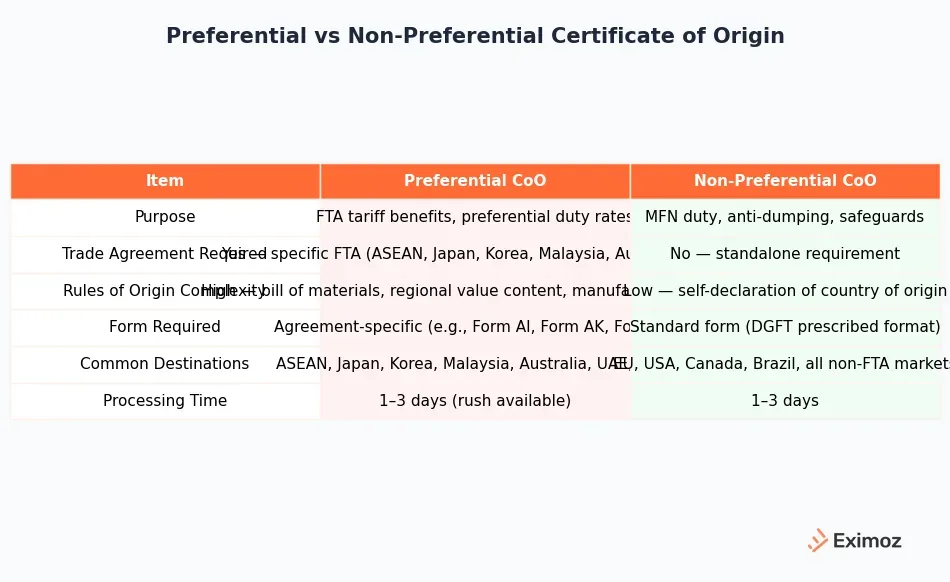
For a preferential DGFT Certificate of Origin, your goods must meet the rules of origin set out in the specific trade agreement. The three most common approaches are:
Wholly obtained. The goods are entirely grown, harvested, or manufactured in India. Common for agricultural products, minerals, and simple manufactures with no foreign inputs.
Change of tariff classification (CTC). Manufacturing changes the product's HS code at a specified level. For instance, raw cotton under Chapter 52 processed into cotton fabric under Chapter 60 satisfies this rule in several of India's FTAs.
Percentage-based rules. A minimum share of the goods' value must originate in India. India's CEPAs with Japan and Korea typically require 35–60% local content depending on the product category.
Keep clear records of your bill of materials, where each input is sourced from, and what happens at each stage of manufacturing. This documentation is critical if the importing country's customs authority questions your origin claim — and it will if the duty differential is significant.
What Is a Back-to-Back CoO and Who Needs It?
A Back-to-Back CoO is a Certificate of Origin issued for goods that have been exported from India to another country (typically a third-country intermediary), processed or manufactured further there, and then re-exported to a final destination. The Back-to-Back CoO allows the Indian exporter to claim origin for the value added in India, even when the final shipment does not directly leave Indian shores.
This mechanism was formally introduced through Public Notice 43/2024-25 dated 27 January 2025 and is available to exporters who:
- Export intermediates or components from India to a second country for further manufacturing or assembly
- Operate within global value chains where processing stages span multiple countries
- Need to prove Indian origin for the value added domestically before the final product enters a preferential market
The key difference from a regular CoO is that a Back-to-Back CoO requires documentation showing the original Indian export, the processing done abroad, and the subsequent re-export — it is not a standalone declaration but a chained certificate tied to the original shipment from India. Exporters in engineering, chemicals, and textiles sectors who work with overseas subcontractors or toll manufacturers are the most common users of this mechanism.
For more on HS code classification that underpins origin determination, see our HSN code guide.
What Documents Do You Need for a DGFT Certificate of Origin Application?
The checklist depends on whether you are applying for preferential or non-preferential, but here is the full set:
Standard documents for both types:
- Completed application form (agency-specific or portal-generated via coo.dgft.gov.in)
- Commercial invoice showing FOB or CIF value
- Packing list itemising the shipment
- Certificate of manufacturing or processor declaration confirming production location
- Bill of Lading or Airway Bill
- Fee payment receipt
- Copy of the exporter's DGFT Importer-Exporter Code (IEC)
Additional documents for preferential DGFT CoO:
- Trade agreement-specific form (Form A, Form AI, or equivalent as prescribed by the specific FTA)
- Rules-of-origin documentation: bill of materials, bill of conversion, or manufacturing process sheet
- Manufacturer's declaration confirming local content percentage where applicable
- Sourcing declarations for inputs imported from third countries
For Back-to-Back CoO (per Public Notice 43/2024-25):
- Original CoO issued for the intermediate export from India
- Documentation of the processing or manufacturing done in the intermediate country
- Re-export documentation showing the goods moving to the final destination
The DGFT does not prescribe a single universal format. Each authorized agency has its own application form, and each trade agreement has its own certificate format. Check with your agency before filing, especially if you are applying for a preferential certificate under an FTA you have not used before.
For calculating applicable import duties on inputs sourced from abroad, use our import duty calculator.
Common Mistakes When Filing a DGFT Certificate of Origin
Applying for the wrong type. Some exporters file for a preferential DGFT CoO when their destination country has no FTA with India, or miss a preferential option entirely because they assumed it was not available. Check the DGFT's FTA portal and confirm whether India has an active agreement with the destination market before deciding.
HS code mismatch on the application. The HS code on your DGFT CoO must match the product description and the rules of origin being claimed. A mismatch can invalidate the preferential tariff claim entirely when the importing country's customs authority reviews it.
Insufficient rules-of-origin documentation. For preferential DGFT CoOs, a verbal or informal declaration is not enough. Incomplete manufacturing records — missing bill of materials, missing supplier declarations for imported inputs — are the most common reason preferential applications get rejected or challenged post-clearance.
Filing with the wrong agency. Pharmaceuticals, chemicals, and agricultural products may require certification from the relevant Export Promotion Council or Commodity Board rather than a general chamber of commerce. Using the wrong agency means your certificate may not be accepted by the importing country's authorities.
Presenting an expired certificate. Preferential DGFT CoOs usually remain valid for 12 months from the date of issue, though this varies by trade agreement. An expired certificate means the preferential rate is denied and full MFN duties are applied — sometimes with back-dated interest.
For a full overview of DGFT services available to Indian exporters, visit our DGFT services guide.
Frequently Asked Questions
Who issues a DGFT Certificate of Origin in India?
A DGFT Certificate of Origin is issued by authorized agencies designated by DGFT: Regional Chambers of Commerce and Industry, Export Promotion Councils such as EEPC India, APEDA, and CAPEXIL, and certain Commodity Boards. FICCI and CII also issue CoOs for their members. The right agency depends on your product category and the trade agreement under which you are filing.
What is the difference between a preferential and non-preferential DGFT Certificate of Origin?
A preferential DGFT CoO is used to claim reduced or zero tariffs under India's Free Trade Agreements such as the India-ASEAN Agreement or India-Korea CEPA. A non-preferential DGFT CoO applies when no FTA benefit is available — for MFN duty rates, anti-dumping duties, country-of-origin labelling, or GSP schemes in the EU, US, or Canada.
How long does it take to get a DGFT Certificate of Origin?
Standard processing through a Chamber of Commerce or Export Promotion Council takes one to two working days. Same-day or 24-hour rush processing is available at most agencies for an additional fee. The eCoO 2.0 portal has reduced digital processing turnaround for participating agencies, though preferential applications with complex rules-of-origin documentation may still require manual review.
Can I apply for a DGFT Certificate of Origin online in India?
Yes — the eCoO 2.0 portal at coo.dgft.gov.in is DGFT's official platform for online CoO filing and supports both preferential and non-preferential certificates. From 1 January 2025, non-preferential CoO applications must be filed through this portal. The exporter manual provides step-by-step guidance for the filing process.
What documents are required for a DGFT Certificate of Origin application?
The standard set is an application form, commercial invoice, packing list, certificate of manufacturing or processor declaration, Bill of Lading or Airway Bill, fee payment receipt, and a copy of your IEC. For a preferential DGFT CoO under an FTA, you also need the agreement-specific form, rules-of-origin evidence such as a bill of materials, and sometimes a manufacturer's declaration confirming local content.
What is a Back-to-Back CoO and who needs it?
A Back-to-Back CoO is a Certificate of Origin issued for goods exported from India to a second country for further manufacturing, then re-exported to a final destination. Introduced via Public Notice 43/2024-25 dated 27 January 2025, it allows Indian exporters in global value chains — particularly in engineering, chemicals, and textiles — to claim origin for the value added in India even when the final shipment passes through an intermediate country. It requires documentation of the original Indian export, the processing abroad, and the re-export to the final market.
What happens if my DGFT Certificate of Origin is challenged at the importing country's border?
If an importing country's customs authority questions your DGFT CoO or rules-of-origin claim, the burden of proof falls on the exporter to demonstrate compliance. This means having contemporaneous documentation: bill of materials, supplier declarations for imported inputs, and manufacturing records that show the product meets the relevant rules of origin. Without those records, the preferential tariff rate is denied, back-dated duties are assessed, and the shipment may be held pending investigation.
Is the DGFT Certificate of Origin mandatory for all Indian exports?
No — a CoO is required only when the importing country's regulations demand it, or when you want to claim preferential tariff treatment under an FTA. Without it, your buyer pays full duties. Since 1 January 2025, however, electronic filing of non-preferential CoOs via the DGFT eCoO 2.0 portal has become mandatory for all Indian exporters.
Getting a DGFT Certificate of Origin right is a combination of knowing which type to apply for, filing with the right agency or portal, and maintaining the documentation to support your rules-of-origin claim. Each step is straightforward on its own; the risk is doing them in the wrong sequence or assuming the documentation can be assembled later.
Eximoz automates the trade compliance pipeline for Indian exporters — from HS code classification through document verification and regulatory flag checks. If your team handles export volumes and you want to see what automated compliance checking looks like before your next shipment sails, book a 15-minute call with us.
Author: Riya | Eximoz Blog Researcher