

APEDA registration is mandatory for exporters of scheduled agricultural and processed food products from India. APEDA (Agricultural and Processed Food Products Export Development Authority) issues the Registration-cum-Membership Certificate (RCMC) online through the DGFT portal (dgft.gov.in) under the e-RCMC module. The fee is ₹5,000 + 18% GST = ₹5,900 total, valid for 5 years. You need this certificate to export basmati rice, fruits, vegetables, meat, dairy, processed foods, and other items listed in the Schedule to the APEDA Act, 1985.
What is APEDA and why is registration mandatory for food exporters?
APEDA stands for Agricultural and Processed Food Products Export Development Authority. It was set up in 1986 under the APEDA Act, 1985 and operates under the Ministry of Commerce and Industry.
Its job: promote and regulate the export of scheduled agricultural products from India. The word "scheduled" matters. APEDA only covers products listed in the Schedule to the Act — fruits, vegetables, meat, poultry, dairy, cereals (including basmati and non-basmati rice), processed foods, groundnuts, floriculture products, and alcoholic beverages.
APEDA does not cover spices (Spices Board), tea (Tea Board), coffee (Coffee Board), tobacco (Tobacco Board), or cashew (CEPCI). Each has its own commodity board under the Ministry of Commerce.
APEDA is also different from FSSAI. FSSAI regulates food safety for the domestic market. APEDA regulates export eligibility and quality for international markets. Many agricultural exporters need both, but they serve different purposes.
Why is registration mandatory? Without a valid APEDA RCMC, customs will not let your agricultural shipment clear for export. The DGFT's Foreign Trade Policy requires an RCMC from the relevant Export Promotion Council for claiming export benefits. Exporters shipping scheduled products without registration face penalties under the Foreign Trade (Development & Regulation) Act, 1992, including fines and suspension of their IEC.
How to register with APEDA online step by step?
Since July 2023, APEDA registration happens entirely on the DGFT portal, not on the APEDA website. This change came through DGFT Trade Notice 35/2021-22.
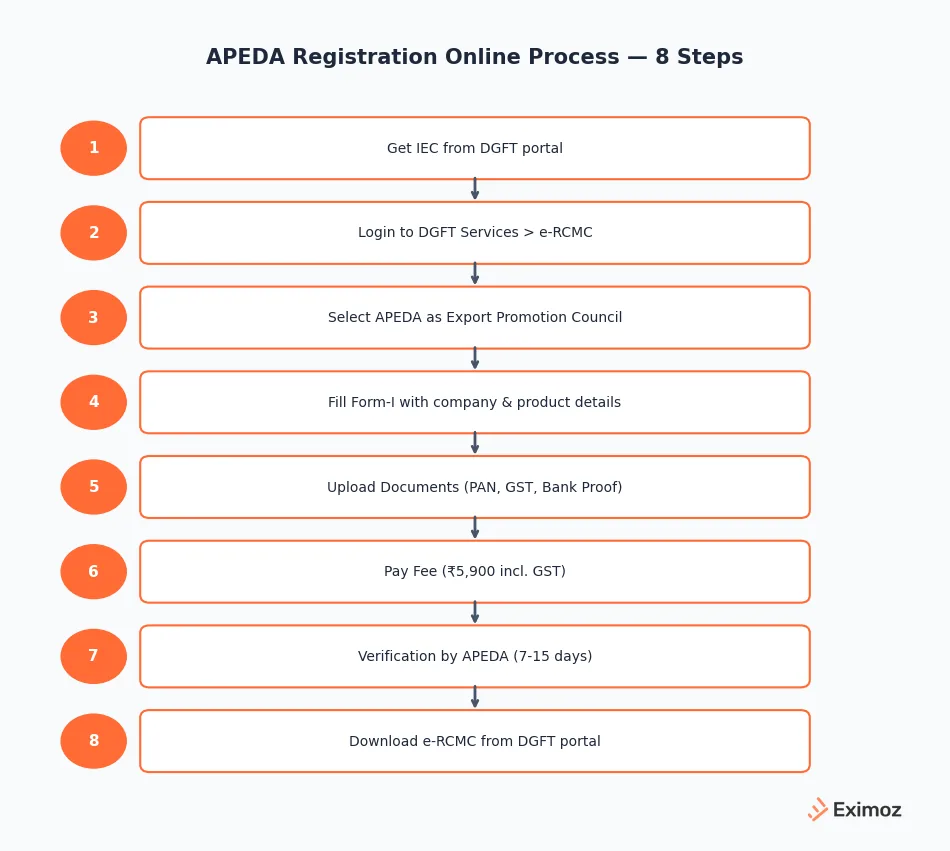 Figure 1: Step-by-step online registration process for APEDA RCMC through the DGFT e-RCMC portal
Step 1: Get your IEC from DGFT. This is a prerequisite — you cannot apply without an active Importer-Exporter Code.
Step 2: Log in to the DGFT portal (dgft.gov.in). Go to Services > e-RCMC.
Step 3: Select APEDA as your Export Promotion Council from the dropdown.
Step 4: Fill in Form-I with your company details, IEC number, product categories you want to export, and bank account information. Be precise with product categories — selecting the wrong one is a common cause of delays.
Step 5: Upload your documents (see next section). Have everything scanned and ready. Incomplete uploads are the biggest cause of rejection.
Step 6: Pay the fee online. ₹5,000 + 18% GST = ₹5,900 total through the DGFT payment gateway.
Step 7: Wait for verification. APEDA verifies your application through the DGFT portal. This takes 7 to 15 working days if documents are complete.
Step 8: Download your registration certificate from the DGFT portal. No physical certificate is issued.
If your application sits for more than 15 working days, check the portal for any query raised against it — sometimes the system flags an issue but the notification gets buried.
What documents are required for APEDA registration?
Keep these ready before you start. Missing even one means your application gets returned.
| Document | Details | Format |
|---|---|---|
| IEC certificate | Active IEC issued by DGFT | PDF copy |
| PAN card | PAN of the company or proprietor | PDF copy |
| GST registration certificate | Active GSTIN | PDF copy |
| Bank account details | Current account in company name + cancelled cheque | PDF/scanned copy |
| Company registration proof | MOA/AOA for companies, partnership deed for firms, Udyam for MSME | PDF copy |
| FSSAI licence | Required only if exporting processed food products | PDF copy |
| Manufacturing unit address proof | Required if you have a processing/manufacturing facility | Utility bill or lease deed |
IEC and PAN must match — if the IEC is in the company's name but the PAN is the proprietor's personal PAN, the application will be flagged.
FSSAI licence is not always required. Fresh fruit and vegetable exporters do not need it for APEDA registration.
What products come under APEDA's jurisdiction?
The full list is in the Schedule to the APEDA Act, 1985. APEDA's product catalogue groups these into 14 categories:
| Product category | HS chapter | Additional certification needed |
|---|---|---|
| Basmati rice | 1006 | Certificate of Inspection (APEDA labs) |
| Non-basmati rice | 1006 | Phytosanitary Certificate (NPPO) |
| Fresh fruits | 0804–0810 | Phytosanitary Certificate (NPPO) |
| Fresh vegetables | 0701–0714 | Phytosanitary Certificate (NPPO) |
| Meat and poultry | 0201–0207 | EIC/Halal Certificate |
| Dairy products | 0401–0406 | FSSAI + EIC Certificate |
| Processed foods | 2001–2009 | FSSAI Licence |
| Groundnuts | 1202 | Aflatoxin Testing (per EU Reg 2023/915) |
| Floriculture | 0603 | Phytosanitary Certificate (NPPO) |
| Alcoholic beverages | 2204–2208 | State Excise Permit |
| Organic products | Various | NPOP/PGS Certification (APEDA-accredited CB) |
| Cereals (wheat, millets, etc.) | 1001–1008 | Phytosanitary Certificate (NPPO) |
Source: India's Customs Tariff Act, 1975 (as amended) read with the ITC-HS Classification published by DGFT.
To check if your product needs APEDA registration: look up your product's HS code in the ITC-HS published by DGFT, then cross-reference with the APEDA Schedule at apeda.gov.in.
What benefits do APEDA-registered exporters get?
APEDA runs three funded schemes that registered exporters can claim from. Most exporters either don't know these exist or assume the paperwork isn't worth it.
Financial Assistance Scheme (FAS) for 2021–26: Covers infrastructure development (packhouses, cold storage, refrigerated transport), quality development (up to 50% reimbursement for food safety certifications like HACCP and ISO 22000, capped between ₹5–20 lakh per certification), and market development (up to 50% of costs for market feasibility studies, capped at ₹10 lakh per study). Exporters from NE states, Himalayan states, or SC/ST/women categories get up to 75% reimbursement on market development.
Transport and Marketing Assistance (TMA) scheme: Administered by DGFT, this reimburses a portion of international freight costs. Sample rates per TEU:
| Destination | Normal container (₹/TEU) | Reefer container (₹/TEU) |
|---|---|---|
| Gulf | 12,600 | 21,000 |
| Europe | 14,200 | 31,500 |
| North America | 31,500 | 43,050 |
| ASEAN | 8,400 | 18,900 |
| South America | 35,700 | 47,250 |
Source: Ministry of Commerce press release, 10 September 2021.
Other services: APEDA operates testing labs for basmati rice Certificates of Inspection, manages India's NPOP organic certification programme (recognized by the EU, Switzerland, and Taiwan), and runs traceability platforms — GrapeNet, HortiNet, AnarNet, and PeanutNet — for farm-to-port documentation.
Frequently Asked Questions
What is the full form of APEDA?
APEDA stands for Agricultural and Processed Food Products Export Development Authority. It was established in 1986 under the APEDA Act, 1985 and functions under the Ministry of Commerce and Industry.
How much does APEDA registration cost?
APEDA registration costs ₹5,000 + 18% GST = ₹5,900 total for a 5-year validity period. Renewal costs the same. The fee is paid online through the DGFT e-RCMC portal. There are no hidden fees from APEDA's side, though you will pay separately for lab testing or product-specific certifications.
How long does APEDA registration take?
7 to 15 working days after submitting all documents correctly. Common delays happen because of incomplete bank details, missing IEC reference, or selecting the wrong product category. The certificate is issued digitally through the DGFT portal.
Is APEDA registration mandatory for all food products?
No. APEDA registration is mandatory only for products in the Schedule to the APEDA Act, 1985, which covers 14 product groups including fruits, vegetables, meat, dairy, cereals, processed foods, groundnuts, floriculture, and alcoholic beverages. Products outside this list have their own regulatory bodies — Spices Board, Tea Board, Coffee Board, Tobacco Board, or CEPCI for cashew.
Can I export basmati rice without APEDA registration?
No. Basmati rice export requires APEDA registration plus a Certificate of Inspection from APEDA labs that verifies grain length, aroma, moisture content, and pesticide residue levels. Recent quality controls have tightened further for EU-bound shipments under EU Regulation 2023/915.
Getting the right registration for your agricultural export product is the first step, but knowing which registration you actually need is where most exporters waste time. Eximoz maps your product's HS code to the exact regulatory requirement — whether that is APEDA, Spices Board, FSSAI, or a Phytosanitary Certificate — so you start the export process with the right paperwork from day one. Check it out at eximoz.com.